About this ebook
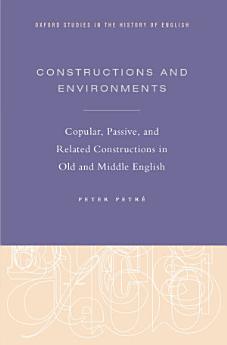
This monograph presents the first comprehensive diachronic account of copular and passive verb constructions in Old and Middle English. Peter Petré analyzes: · The mysterious loss of the high-frequency verb weorðan 'become' as a casualty of changing word order in narrative during Middle English. · The merger of is 'is' and bið 'shall be, is generally' into a single suppletive verb, and how it is related to the development of a general analytic future shall be. · The co-occurrence of multiple changes that led to become and wax crossing a threshold of similarity with existing copulas, from which they analogically adopted full productivity in one fell swoop. In explaining each of these changes, Petré goes beyond the level of the verb and its complements, drawing attention to analogical networks and the importance of a verb's embeddedness in clausal and textual environments. Using a radically usage-based approach, treating syntax as emerging from (changing) frequencies, Petré draws attention to general principles of constructional change, including but not limited to grammaticalization and lexicalization. He proposes novel parallelisms between linguistic and ecological evolution. Going beyond the view of language change as propagating only in social interaction, Petré explains how each individual's mental grammar can be seen as a dynamic ecosystem with hierarchical environments (clausal niches, textual habitats). In this view, the interconnectedness of seemingly unrelated changes, itself resulting from cognitive economy principles, is arguably more decisive in lexical change than is functional competition.
This monograph presents the first comprehensive diachronic account of copular and passive verb constructions in Old and Middle English. Peter Petré analyzes: · The mysterious loss of the high-frequency verb weorðan 'become' as a casualty of changing word order in narrative during Middle English. ...
About the author
Peter Petré holds a PhD in linguistics from the KU Leuven (University of Leuven). His research aims at keeping a wide view, combining insights and research methods from linguistics, history, philosophy, and research on evolutionary systems.
Peter Petré holds a PhD in linguistics from the KU Leuven (University of Leuven). His research aims at keeping a wide view, combining insights and research methods from linguistics, history, philosophy, and research on evolutionary systems.
Rate this ebook
Tell us what you think.
Reading information
Smartphones and tablets
Install the Google Play Books app for Android and iPad/iPhone. It syncs automatically with your account and allows you to read online or offline wherever you are.
Laptops and computers
You can listen to audiobooks purchased on Google Play using your computer's web browser.
eReaders and other devices
To read on e-ink devices like Kobo eReaders, you'll need to download a file and transfer it to your device. Follow the detailed Help Center instructions to transfer the files to supported eReaders.