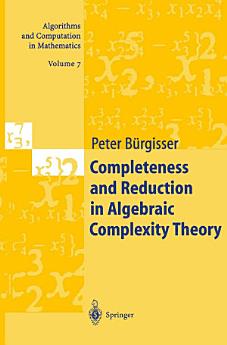
Completeness and Reduction in Algebraic Complexity Theory
Mar 2013 · Springer Science & Business Media
Ebook
168
Pages
About this ebook
One of the most important and successful theories in computational complex ity is that of NP-completeness. This discrete theory is based on the Turing machine model and achieves a classification of discrete computational prob lems according to their algorithmic difficulty. Turing machines formalize al gorithms which operate on finite strings of symbols over a finite alphabet. By contrast, in algebraic models of computation, the basic computational step is an arithmetic operation (or comparison) of elements of a fixed field, for in stance of real numbers. Hereby one assumes exact arithmetic. In 1989, Blum, Shub, and Smale [12] combined existing algebraic models of computation with the concept of uniformity and developed a theory of NP-completeness over the reals (BSS-model). Their paper created a renewed interest in the field of algebraic complexity and initiated new research directions. The ultimate goal of the BSS-model (and its future extensions) is to unite classical dis crete complexity theory with numerical analysis and thus to provide a deeper foundation of scientific computation (cf. [11, 101]). Already ten years before the BSS-paper, Valiant [107, 110] had proposed an analogue of the theory of NP-completeness in an entirely algebraic frame work, in connection with his famous hardness result for the permanent [108]. While the part of his theory based on the Turing approach (#P-completeness) is now standard and well-known among the theoretical computer science com munity, his algebraic completeness result for the permanents received much less attention.
One of the most important and successful theories in computational complex ity is that of NP-completeness. This discrete theory is based on the Turing machine model and achieves a classification of discrete computational prob lems according to their algorithmic difficulty. Turing machines formali...
Discover more
Rate this ebook
Tell us what you think.
Reading information
Smartphones and tablets
Install the Google Play Books app for Android and iPad/iPhone. It syncs automatically with your account and allows you to read online or offline wherever you are.
Laptops and computers
You can listen to audiobooks purchased on Google Play using your computer's web browser.
eReaders and other devices
To read on e-ink devices like Kobo eReaders, you'll need to download a file and transfer it to your device. Follow the detailed Help Center instructions to transfer the files to supported eReaders.