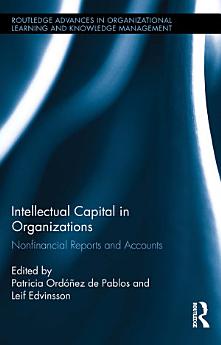
Intellectual Capital in Organizations: Non-Financial Reports and Accounts

·
· Routledge
Ebook
334
Pages
Eligible

About this ebook

In a global competitive economic environment, resources that are scarce or irreplicable are a source of sustained competitive advantage for companies and organizations. Knowledge-based resources are a major and increasing driver of long term competitive advantage. Most accounting standards however do not allow for knowledge-based resource calculations, including the most important of these, intellectual capital. Intellectual capital is the collective knowledge, documented and otherwise, of individuals in an organization. In the absence of accounting standards to numerically evaluate intellectual capital, some institutions have devised their own reports and statements. But why should companies, universities, and research centers measure these resources? How are intellectual capital statements built? How does one set targets, and what indicators should they include?

This book reviews the development of the field of intellectual capital reporting, including core concepts, latest developments, the main components of intellectual capital, how a statement is built, and key indicators of each component. It further analyzes experiences from a variety of pioneering companies and institutions around the globe in measuring intellectual capital, including case studies from educational and research institutions, and provides crucial transnational comparisons. Authors Ordóñez de Pablos and Edvinsson examine the challenges and next steps for the harmonization of intellectual capital reports, consider the creation of a special international agency for intellectual capital reporting standards, and evaluate the weaknesses of current standards and how they might be overcome.

In a global competitive economic environment, resources that are scarce or irreplicable are a source of sustained competitive advantage for companies and organizations. Knowledge-based resources are a major and increasing driver of long term competitive advantage. Most accounting standards howeve...

Discover more

About the author

Patricia Ordóñez de Pablos is Professor in the Department of Business Administration and Accountability in the Faculty of Economics at the University of Oviedo, Spain. Her teaching and research interests focus on the areas of strategic management, knowledge management, intellectual capital, and China. She serves as an Associate Editor for the Behaviour and Information Technology journal and is Editor-in-Chief of the International Journal of Learning and Intellectual Capital and the International Journal of Strategic Change Management.

Leif Edvinsson

is Professor of Intellectual Capital at Lund University, Sweden and Chair Professor at Hong Kong Polytechnic University. He is a key pioneering contributor to both the theory and practice of intellectual capital. He is the author of numerous journal articles on service management and intellectual capital, and in 1997 co-authored (along with Michael S. Malone) one of the first books on intellectual capital. He serves as special advisor on Societal Entrepreneurship to the Swedish Governmental Foundation for Competence Development and to the Swedish Governmental Agency for Innovation.
Patricia Ordóñez de Pablos is Professor in the Department of Business Administration and Accountability in the Faculty of Economics at the University of Oviedo, Spain. Her teaching and research interests focus on the areas of strategic management, knowledge management, intellectual capital, and C...

Rate this ebook

Tell us what you think.

Reading information

Smartphones and tablets
Install the Google Play Books app for Android and iPad/iPhone. It syncs automatically with your account and allows you to read online or offline wherever you are.
Laptops and computers
You can listen to audiobooks purchased on Google Play using your computer's web browser.
eReaders and other devices
To read on e-ink devices like Kobo eReaders, you'll need to download a file and transfer it to your device. Follow the detailed Help Center instructions to transfer the files to supported eReaders.