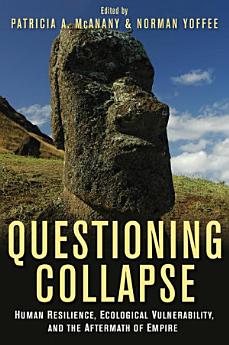
Questioning Collapse: Human Resilience, Ecological Vulnerability, and the Aftermath of Empire

·
· Cambridge University Press
1 review
Ebook
390
Pages

About this ebook

Questioning Collapse challenges those scholars and popular writers who advance the thesis that societies - past and present - collapse because of behavior that destroyed their environments or because of overpopulation. In a series of highly accessible and closely argued essays, a team of internationally recognized scholars bring history and context to bear in their radically different analyses of iconic events, such as the deforestation of Easter Island, the cessation of the Norse colony in Greenland, the faltering of nineteenth-century China, the migration of ancestral peoples away from Chaco Canyon in the American southwest, the crisis and resilience of Lowland Maya kingship, and other societies that purportedly 'collapsed'. Collectively, these essays demonstrate that resilience in the face of societal crises, rather than collapse, is the leitmotif of the human story from the earliest civilizations to the present. Scrutinizing the notion that Euro-American colonial triumphs were an accident of geography, Questioning Collapse also critically examines the complex historical relationship between race and political labels of societal 'success' and 'failure'.
Questioning Collapse challenges those scholars and popular writers who advance the thesis that societies - past and present - collapse because of behavior that destroyed their environments or because of overpopulation. In a series of highly accessible and closely argued essays, a team of internat...

Ratings and reviews

1 review
geek01
March 8, 2023
Authors seem to think that nothing of value was lost when any of these highly organized societies ceased to exist and the few survivors are living on the edge of extinction.
Did you find this helpful?

About the author

Patricia A. McAnany is Kenan Eminent Professor in the anthropology department at the University of North Carolina, Chapel Hill. A member of the editorial board of the Journal of Anthropological Archaeology, she has received fellowships from the National Endowment for the Humanities, Dumbarton Oaks, and the Radcliffe Institute for Advanced Study at Harvard University. She is the principal investigator of the Xibun Archaeological Research Project in Belize (www.bu.edu/tricia) and of the Maya Area Cultural Heritage Initiative (www.machiproject.org) that works with descendent Maya communities. She has authored Living with the Ancestors: Kinship and Kingship in Ancient Maya Society, edited Kxob: Ritual, Work and Family in an Ancient Maya Village, and recently co-edited Dimensions of Ritual Economy.

Norman Yoffee is a scholar of ancient Mesopotamia and social evolutionary and anthropological theory. He teaches in the Departments of Near Eastern Studies and Anthropology at the University of Michigan, Ann Arbor. He is the author and editor of eleven books, including Myths of the Archaic State: Evolution of the Earliest Cities, States, and Civilizations, Excavating Asian History: Interdisciplinary Studies in History and Archaeology and Negotiating the Past in the Past: Identity, Memory, and Landscape in Archaeological Research, and the Cambridge World Archaeology series.
Patricia A. McAnany is Kenan Eminent Professor in the anthropology department at the University of North Carolina, Chapel Hill. A member of the editorial board of the Journal of Anthropological Archaeology, she has received fellowships from the National Endowment for the Humanities, Dumbarton Oak...

Rate this ebook

Tell us what you think.

Reading information

Smartphones and tablets
Install the Google Play Books app for Android and iPad/iPhone. It syncs automatically with your account and allows you to read online or offline wherever you are.
Laptops and computers
You can listen to audiobooks purchased on Google Play using your computer's web browser.
eReaders and other devices
To read on e-ink devices like Kobo eReaders, you'll need to download a file and transfer it to your device. Follow the detailed Help Center instructions to transfer the files to supported eReaders.