About this ebook
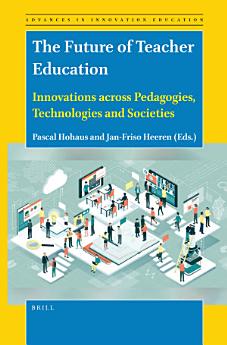
Twenty-first century processes, such as globalization and digitization, pose various challenges for primary, secondary, and post-secondary teacher education at both the formal and informal education levels. These challenges are addressed by innovators in the field of teacher education, i.e. teacher educators, pre-service teachers, in-service teachers, scholars and policy-makers. This edited volume explores future trends in three different spheres of teacher education: 1) pedagogies (emotive, reflective, cognitive, and didactic practices), 2) technologies (digital competencies, artificial intelligence in teaching, and the transformative potential of digital tools in intercultural learning), and 3) societies (multilingualism, attitudes towards literacies, societal polarization, and teacher shortages).
The suggested innovations aim to bridge the gap between theory and practice by drawing upon the critical evaluation of theoretical approaches as well as the discussion of best practice examples. The chapters are situated in various countries, such as Vietnam, Canada, Argentina, Spain, Germany, the USA, Switzerland, Sweden, Italy, and, as a transnational cooperation, Palestine and the UK. The Future of Teacher Education: Innovations across Pedagogies, Technologies and Societies considers various models of teacher education (e.g. reflective model, competency-based model, etc.) and applies a multitude of different research methods (e.g. didactic analysis of teaching material, thematic analysis of reflections, etc.).
The suggested innovations aim to bridge the gap between theory and practice by drawing upon the critical evaluation of theoretical approaches as well as the discussion of best practice examples. The chapters are situated in various countries, such as Vietnam, Canada, Argentina, Spain, Germany, the USA, Switzerland, Sweden, Italy, and, as a transnational cooperation, Palestine and the UK. The Future of Teacher Education: Innovations across Pedagogies, Technologies and Societies considers various models of teacher education (e.g. reflective model, competency-based model, etc.) and applies a multitude of different research methods (e.g. didactic analysis of teaching material, thematic analysis of reflections, etc.).
Twenty-first century processes, such as globalization and digitization, pose various challenges for primary, secondary, and post-secondary teacher education at both the formal and informal education levels. These challenges are addressed by innovators in the field of teacher education, i.e. teach...
Discover more
About the author
Pascal Hohaus studied English and Political Sciences as part of a teacher training degree at Leibniz University Hannover. His doctoral dissertation Subordinating Modalities: A Quantitative Analysis of Syntactically Dependent Modal Verb Constructions (J. B. Metzler, 2020) applies construction grammar to the use of modal verbs in subordinate clauses. He co-edited Re-Assessing Modalising Expressions: Categories, Co-text, and Context (John Benjamins, 2020) and recently he edited Science Communication in Times of Crisis (John Benjamins, 2022). Further research interests include the interplay of teaching and research and applying linguistics to the teaching of foreign languages.
Jan-Friso Heeren studied English, Chemistry and Physical Education as part of a teacher training degree at Leibniz University Hannover. There, he has been working as a research assistant at Englisches Seminar. His master’s thesis is entitled Establishing a Mechanism-Based Framework for the Corpus-Informed Analysis of Multi-Word Discourse Markers (Springer, 2022). His research focuses on teacher education and its application in the classroom.
Jan-Friso Heeren studied English, Chemistry and Physical Education as part of a teacher training degree at Leibniz University Hannover. There, he has been working as a research assistant at Englisches Seminar. His master’s thesis is entitled Establishing a Mechanism-Based Framework for the Corpus-Informed Analysis of Multi-Word Discourse Markers (Springer, 2022). His research focuses on teacher education and its application in the classroom.
Pascal Hohaus studied English and Political Sciences as part of a teacher training degree at Leibniz University Hannover. His doctoral dissertation Subordinating Modalities: A Quantitative Analysis of Syntactically Dependent Modal Verb Constructions (J. B. Metzler, 2020) applies construction gram...
Rate this ebook
Tell us what you think.
Reading information
Smartphones and tablets
Install the Google Play Books app for Android and iPad/iPhone. It syncs automatically with your account and allows you to read online or offline wherever you are.
Laptops and computers
You can listen to audiobooks purchased on Google Play using your computer's web browser.
eReaders and other devices
To read on e-ink devices like Kobo eReaders, you'll need to download a file and transfer it to your device. Follow the detailed Help Center instructions to transfer the files to supported eReaders.