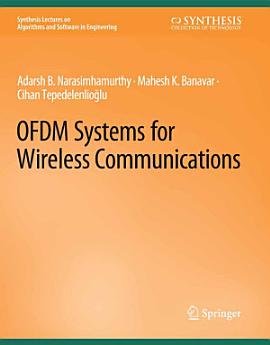
OFDM Systems for Wireless Communications
thg 6 2022 · Springer Nature
Sách điện tử
68
Trang
Giới thiệu về sách điện tử này
Orthogonal Frequency Division Multiplexing (OFDM) systems are widely used in the standards for digital audio/video broadcasting, WiFi and WiMax. Being a frequency-domain approach to communications, OFDM has important advantages in dealing with the frequency-selective nature of high data rate wireless communication channels. As the needs for operating with higher data rates become more pressing, OFDM systems have emerged as an effective physical-layer solution. This short monograph is intended as a tutorial which highlights the deleterious aspects of the wireless channel and presents why OFDM is a good choice as a modulation that can transmit at high data rates. The system-level approach we shall pursue will also point out the disadvantages of OFDM systems especially in the context of peak to average ratio, and carrier frequency synchronization. Finally, simulation of OFDM systems will be given due prominence. Simple MATLAB programs are provided for bit error rate simulation using a discrete-time OFDM representation. Software is also provided to simulate the effects of inter-block-interference, inter-carrier-interference and signal clipping on the error rate performance. Different components of the OFDM system are described, and detailed implementation notes are provided for the programs. The program can be downloaded here. Table of Contents: Introduction / Modeling Wireless Channels / Baseband OFDM System / Carrier Frequency Offset / Peak to Average Power Ratio / Simulation of the Performance of OFDM Systems / Conclusions
Orthogonal Frequency Division Multiplexing (OFDM) systems are widely used in the standards for digital audio/video broadcasting, WiFi and WiMax. Being a frequency-domain approach to communications, OFDM has important advantages in dealing with the frequency-selective nature of high data rate wire...
Khám phá thêm
Giới thiệu tác giả
Adarsh Narasimhamurthy is a Ph.D. candidate at the School of Electrical, Computer and Energy Engineering in Arizona State University, Tempe. He obtained his B.E. with distinction in 2005 from the Bangalore University, Karnataka, India and the M.S. degree in Electrical Engineering from Arizona State University, Tempe in 2007. Currently, he is a part of the Signal Processing for Wireless Communications Lab headed by Dr. Cihan Tepedelenlio ̆glu and also a member of the SenSIP consortium. Mr. Narasimhamurthy was awarded a Research Assistantship in the year 2006 and the subsequent year a Graduate Teaching Associate position from the Department of Electrical Engineering. His research interests include MIMO systems, OFDM systems, reduced complexity diversity combining techniques and multiuser communication. Mr. Narasimhamurthy is also a member of the Eta Kappa Nu honor society and an IEEE student member. Mahesh K. Banavar received the B.E. degree in telecommunications engineering from Visvesvaraya Technological University, Karnataka, India, in 2005 and the M.S. degree in electrical engineering from Arizona State University, Tempe, in 2008. He is pursuing the Ph.D. degree with Arizona State University, specializing in Signal Processing and Communications, and doing research in wireless communications and sensor networks. Mr. Banavar is a member of the Eta Kappa Nu electrical and computer engineering honor society. Cihan Tepedelenlioglu was born in Ankara, Turkey in 1973.He received his B.S. degree with highest honors from Florida Institute of Technology in 1995, and his M.S. degree from the University of Virginia in 1998, both in Electrical Engineering. From January 1999 to May 2001 he was a research assistant at the University of Minnesota, where he completed his Ph.D. degree in Electrical and Computer Engineering. He is currently an Associate Professor of Electrical Engineering at Arizona State University. He was awarded the NSF (early) Career grant in 2001, and has servedas an Associate Editor for several IEEE Transactions including IEEE Transactions on Communications, and IEEE Signals Processing Letters.
Adarsh Narasimhamurthy is a Ph.D. candidate at the School of Electrical, Computer and Energy Engineering in Arizona State University, Tempe. He obtained his B.E. with distinction in 2005 from the Bangalore University, Karnataka, India and the M.S. degree in Electrical Engineering from Arizona Sta...
Xếp hạng sách điện tử này
Cho chúng tôi biết suy nghĩ của bạn.
Đọc thông tin
Điện thoại thông minh và máy tính bảng
Cài đặt ứng dụng Google Play Sách cho Android và iPad/iPhone. Ứng dụng sẽ tự động đồng bộ hóa với tài khoản của bạn và cho phép bạn đọc trực tuyến hoặc ngoại tuyến dù cho bạn ở đâu.
Máy tính xách tay và máy tính
Bạn có thể nghe các sách nói đã mua trên Google Play thông qua trình duyệt web trên máy tính.
Thiết bị đọc sách điện tử và các thiết bị khác
Để đọc trên thiết bị e-ink như máy đọc sách điện tử Kobo, bạn sẽ cần tải tệp xuống và chuyển tệp đó sang thiết bị của mình. Hãy làm theo hướng dẫn chi tiết trong Trung tâm trợ giúp để chuyển tệp sang máy đọc sách điện tử được hỗ trợ.