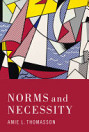
Norms and Necessity
may 2020 · Oxford University Press
Libro electrónico
256
Páginas
Herramientas
info
family_home
Apto
info
Acerca de este libro electrónico
Claims about what is metaphysically necessary or possible have long played a central role in metaphysics and other areas of philosophy. Such claims are traditionally thought of as aiming to describe a special kind of modal fact or property, or perhaps facts about other possible worlds. But that assumption leads to difficult ontological, epistemological, and methodological puzzles. Should we accept that there are modal facts or properties, or other possible worlds? If so, what could these things be? How could we come to know what the modal facts or properties are? How can we resolve philosophical debates about what is metaphysically necessary or possible? Norms and Necessity develops a new approach to understanding our claims about metaphysical possibility and necessity: Modal Normativism. The Normativist rejects the assumption that modal claims aim to describe modal features or possible worlds, arguing instead that they serve as useful ways of conveying, reasoning with, and renegotiating semantic rules and their consequences. By dropping the descriptivist assumption, the Normativist is able to unravel the notorious ontological problems of modality, and provide a clear and plausible story about how we can come to know what is metaphysically necessary or possible. Most importantly, this approach helps demystify philosophical methodology. It reveals that resolving metaphysical modal questions does not require a special form of philosophical insight or intuition. Instead, it requires nothing more mysterious than empirical knowledge, conceptual mastery, and an ability to explicitly convey and renegotiate semantic rules.
Claims about what is metaphysically necessary or possible have long played a central role in metaphysics and other areas of philosophy. Such claims are traditionally thought of as aiming to describe a special kind of modal fact or property, or perhaps facts about other possible worlds. But that a...
Acerca del autor
Amie L. Thomasson is the Daniel P. Stone Professor of Intellectual and Moral Philosophy at Dartmouth College. She is the author of Ontology Made Easy (Oxford University Press, 2015), Ordinary Objects (Oxford University Press, 2007), and Fiction and Metaphysics (Cambridge University Press, 1999), and co-editor (with David W. Smith) of Phenomenology and Philosophy of Mind (Oxford University Press, 2005). Her book Ontology Made Easy was awarded the American Philosophical Association's 2017 Sanders Book Prize. She has also published more than 70 book chapters and articles on topics in metaphysics, metaontology, fiction, philosophy of mind and phenomenology, the philosophy of art, and social ontology. She has twice held Fellowships with the National Endowment for the Humanities.
Amie L. Thomasson is the Daniel P. Stone Professor of Intellectual and Moral Philosophy at Dartmouth College. She is the author of Ontology Made Easy (Oxford University Press, 2015), Ordinary Objects (Oxford University Press, 2007), and Fiction and Metaphysics (Cambridge University Press, 1999), ...
Califica este libro electrónico
Cuéntanos lo que piensas.
Información de lectura
Smartphones y tablets
Instala la app de Google Play Libros para Android y iPad/iPhone. Como se sincroniza de manera automática con tu cuenta, te permite leer en línea o sin conexión en cualquier lugar.
Laptops y computadoras
Para escuchar audiolibros adquiridos en Google Play, usa el navegador web de tu computadora.
Lectores electrónicos y otros dispositivos
Para leer en dispositivos de tinta electrónica, como los lectores de libros electrónicos Kobo, deberás descargar un archivo y transferirlo a tu dispositivo. Sigue las instrucciones detalladas que aparecen en el Centro de ayuda para transferir los archivos a lectores de libros electrónicos compatibles.