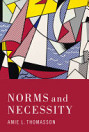
Norms and Necessity
maj 2020 · Oxford University Press
E-bog
256
Sider
Værktøjer
info
family_home
Kvalificeret
info
Om denne e-bog
Claims about what is metaphysically necessary or possible have long played a central role in metaphysics and other areas of philosophy. Such claims are traditionally thought of as aiming to describe a special kind of modal fact or property, or perhaps facts about other possible worlds. But that assumption leads to difficult ontological, epistemological, and methodological puzzles. Should we accept that there are modal facts or properties, or other possible worlds? If so, what could these things be? How could we come to know what the modal facts or properties are? How can we resolve philosophical debates about what is metaphysically necessary or possible? Norms and Necessity develops a new approach to understanding our claims about metaphysical possibility and necessity: Modal Normativism. The Normativist rejects the assumption that modal claims aim to describe modal features or possible worlds, arguing instead that they serve as useful ways of conveying, reasoning with, and renegotiating semantic rules and their consequences. By dropping the descriptivist assumption, the Normativist is able to unravel the notorious ontological problems of modality, and provide a clear and plausible story about how we can come to know what is metaphysically necessary or possible. Most importantly, this approach helps demystify philosophical methodology. It reveals that resolving metaphysical modal questions does not require a special form of philosophical insight or intuition. Instead, it requires nothing more mysterious than empirical knowledge, conceptual mastery, and an ability to explicitly convey and renegotiate semantic rules.
Claims about what is metaphysically necessary or possible have long played a central role in metaphysics and other areas of philosophy. Such claims are traditionally thought of as aiming to describe a special kind of modal fact or property, or perhaps facts about other possible worlds. But that a...
Om forfatteren
Amie L. Thomasson is the Daniel P. Stone Professor of Intellectual and Moral Philosophy at Dartmouth College. She is the author of Ontology Made Easy (Oxford University Press, 2015), Ordinary Objects (Oxford University Press, 2007), and Fiction and Metaphysics (Cambridge University Press, 1999), and co-editor (with David W. Smith) of Phenomenology and Philosophy of Mind (Oxford University Press, 2005). Her book Ontology Made Easy was awarded the American Philosophical Association's 2017 Sanders Book Prize. She has also published more than 70 book chapters and articles on topics in metaphysics, metaontology, fiction, philosophy of mind and phenomenology, the philosophy of art, and social ontology. She has twice held Fellowships with the National Endowment for the Humanities.
Amie L. Thomasson is the Daniel P. Stone Professor of Intellectual and Moral Philosophy at Dartmouth College. She is the author of Ontology Made Easy (Oxford University Press, 2015), Ordinary Objects (Oxford University Press, 2007), and Fiction and Metaphysics (Cambridge University Press, 1999), ...
Bedøm denne e-bog
Fortæl os, hvad du mener.
Oplysninger om læsning
Smartphones og tablets
Installer appen Google Play Bøger til Android og iPad/iPhone. Den synkroniserer automatisk med din konto og giver dig mulighed for at læse online eller offline, uanset hvor du er.
Bærbare og stationære computere
Du kan høre lydbøger, du har købt i Google Play via browseren på din computer.
e-læsere og andre enheder
Hvis du vil læse på e-ink-enheder som f.eks. Kobo-e-læsere, skal du downloade en fil og overføre den til din enhed. Følg den detaljerede vejledning i Hjælp for at overføre filerne til understøttede e-læsere.