या ई-पुस्तकाविषयी
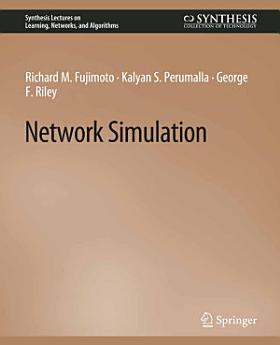
A detailed introduction to the design, implementation, and use of network simulation tools is presented. The requirements and issues faced in the design of simulators for wired and wireless networks are discussed. Abstractions such as packet- and fluid-level network models are covered. Several existing simulations are given as examples, with details and rationales regarding design decisions presented. Issues regarding performance and scalability are discussed in detail, describing how one can utilize distributed simulation methods to increase the scale and performance of a simulation environment. Finally, a case study of two simulation tools is presented that have been developed using distributed simulation techniques. This text is essential to any student, researcher, or network architect desiring a detailed understanding of how network simulation tools are designed, implemented, and used.
A detailed introduction to the design, implementation, and use of network simulation tools is presented. The requirements and issues faced in the design of simulators for wired and wireless networks are discussed. Abstractions such as packet- and fluid-level network models are covered. Several ex...
आणखी डिस्कव्हर करा
लेखकाविषयी
Richard M. Fujimoto is a Professor and Chair of the Computational Science and Engineering Division in the College of Computing at the Georgia Institute of Technology. He received the Ph.D. and M.S. degrees from the University of California (Berkeley) in 1980 and 1983 (Computer Science and Electrical Engineering) and the B.S. degrees from the University of Illinois (Urbana) in 1977 and 1978 (Computer Science and Computer Engineering). He has been an active researcher in the parallel and distributed simulation community since 1985. Among his current activities he is the technical lead concerning time management issues for the DoD high level architecture (HLA) effort. He served as an area editor for ACM Transactions on Modeling and Computer Simulation and Co-Editor-in-Chief of the journal Simulation: Transactions of the SCS, and has also been chair of the steering committee for the Workshop on Parallel and Distributed Simulation (PADS) since 1990. He also served as a member of the Conference Committee for the Simulation Interoperability Workshop. Kalyan S. Perumalla is a senior researcher in the Computational Sciences and Engineering Division at the Oak Ridge National Laboratory. He also holds an adjunct faculty appointment with the College of Computing, Georgia Tech. Dr. Perumalla has over 10 years of research and development experience in the area of parallel and distributed simulation systems, and has published widely on these topics. He was instrumental in developing widely disseminated tools such as the μ sik scalable simulation engine for simulations using 1000 or more processors, the Telecommunications Description Language (TeD) for automatically simulating networks in parallel, and the Federated Simulations Development Kit (FDK), a high-performance run-time infrastructure. He has also built several additional research prototype systems and tools (e.g., for distributed debugging, network modeling and parallel optimization). He received a Ph.D. in Computer Science from Georgia Tech in 1999. Dr. Perumalla has served as an investigator on multiple federally funded projects on scalable parallel/distributed discrete event simulation systems. George F. Riley is an Assistant Professor of Electrical and Computer Engineering at the Georgia Institute of Technology. He received his Ph.D. in Computer Science from the Georgia Institute of Technology, College of Computing, in August 2001. His research interests are large-scale simulation using distributed simulation methods. He is the developer of Parallel/Distributed ns2 (PDNS) and the Georgia Tech Network Simulator (GTNetS).
Richard M. Fujimoto is a Professor and Chair of the Computational Science and Engineering Division in the College of Computing at the Georgia Institute of Technology. He received the Ph.D. and M.S. degrees from the University of California (Berkeley) in 1980 and 1983 (Computer Science and Electri...
या ई-पुस्तकला रेटिंग द्या
तुम्हाला काय वाटते ते आम्हाला सांगा.
वाचन माहिती
स्मार्टफोन आणि टॅबलेट
Android आणि iPad/iPhone साठी Google Play बुक अॅप इंस्टॉल करा. हे तुमच्या खात्याने आपोआप सिंक होते आणि तुम्ही जेथे कुठे असाल तेथून तुम्हाला ऑनलाइन किंवा ऑफलाइन वाचण्याची अनुमती देते.
लॅपटॉप आणि कॉंप्युटर
तुम्ही तुमच्या काँप्युटरचा वेब ब्राउझर वापरून Google Play वर खरेदी केलेली ऑडिओबुक ऐकू शकता.
ईवाचक आणि इतर डिव्हाइसेस
Kobo eReaders सारख्या ई-इंक डिव्हाइसवर वाचण्यासाठी, तुम्ही एखादी फाइल डाउनलोड करून ती तुमच्या डिव्हाइसवर ट्रान्सफर करणे आवश्यक आहे. सपोर्ट असलेल्या eReaders वर फाइल ट्रान्सफर करण्यासाठी, मदत केंद्र मधील तपशीलवार सूचना फॉलो करा.