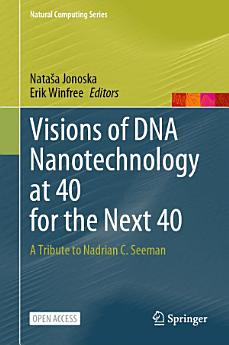
Visions of DNA Nanotechnology at 40 for the Next 40: A Tribute to Nadrian C. Seeman
About this ebook
From this vantage point, what are the untold stories, the unspoken concerns, the underlying fundamental issues, the overlooked opportunities, and the unifying grand challenges? What will help us see more clearly, see more creatively, or see farther? What is transpiring right now that could pave the way for the future? To addressthese questions, leading researchers have contributed 22 chapters, grouped into five sections: perspectives, chemistry and physics, structures, biochemical circuits, and spatial systems.
This book will be an important reference point in the field of DNA nanotechnology, both for established researchers looking to take stock of the field and its future, and for newcomers such as graduate students and researchers in other fields who are beginning to appreciate the power and applicability of its methods.
Discover more
About the author
Erik Winfree is a Professor of Computer Science, Computation and Neural Systems, and Bioengineering at Caltech. Elected a Fellow of the AAAS (2015), he is the recipient of the Feynman Prize for Nanotechnology (2006), a MacArthur Fellowship (2000), and the first Rozenberg Tulip Award in DNA Computing (2000). Prior to starting his research group at Caltech in 2000, he did postdoctoral work at Princeton and was a visiting researcher at MIT. Professor Winfree earned his bachelor's degree in mathematics from the University of Chicago in 1991, and studied computation and neural systems at Caltech, earning his PhD in 1998.