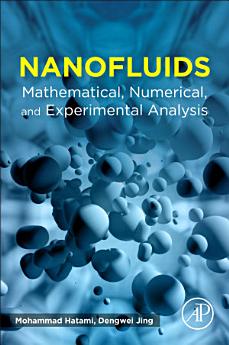
Nanofluids: Mathematical, Numerical, and Experimental Analysis
2020年1月 · Academic Press
電子書
368
頁
family_home
符合資格
info
關於本電子書
Nanofluids: Mathematical, Numerical and Experimental Analysis provides a combined treatment of the numerical and experimental aspects of this crucial topic. Mathematical methods such as the weighted residual method and perturbation techniques, as well as numerical methods such as Finite Element and Lattice-Boltzmann are addressed, along with experimental methods in nanofluid analysis. The effects of magnetic field, electric field and solar radiation on the optical properties and synthesis of nanofluid flow are examined and discussed as well. This book also functions as a comprehensive review of recent progress in nanofluids analysis and its application in different engineering sciences. This book is ideal for all readers in industry or academia, along with anyone interested in nanofluids for theoretical or experimental design reasons. - Explains the governing equations in which magnetic or electric fields are applied - Gives instructions on how to confirm numerical modeling results by comparing with experimental outcomes - Provides detailed information on the governing equations where nanofluids are used as a working fluid
Nanofluids: Mathematical, Numerical and Experimental Analysis provides a combined treatment of the numerical and experimental aspects of this crucial topic. Mathematical methods such as the weighted residual method and perturbation techniques, as well as numerical methods such as Finite Element a...
瀏覽更多書籍
關於作者
Mohammad Hatami is a Mechanical Engineering Associate Professor at Esfarayen University of Technology, Esfarayen, North Khorasan, Iran. He also was an associate professor at Ferdowsi University of Mashhad, and was selected as a young talent associate professor at Xi'an Jiaotong University. He completed his Ph.D. in energy conversion at Babol University of Technology whilst working as a Ph.D. visiting scholar researcher at Eindhoven University of Technology (TU/e) in the Netherlands. Dr. Hatami was previously a post-doctoral researcher at the State Key Laboratory of Multiphase Flow in Power Engineering, Xi'an Jiaotong University, in China. He has published more than 200 research papers and 10 books/chapter books in the field of experimental, mathematical and numerical modelling of nanofluids, heat recovery and acts as editor-in-chief of the Quarterly Journal of Mechanical Engineering and Innovation in Technology, Associate Editor of Fluid Dynamic & Material Processing, and an Editor for the International Journal of Mechanical Engineering (IJME), American Journal of Modelling and Optimization, and American Journal of Mechanical Engineering.Dengwei Jing is Professor of Energy and Power Engineering at Xi'an Jiaotong University. His research focuses on transport phenomena in solar hydrogen production and renewable energy systems, including multiphase flow, enhanced heat and mass transfer, photo/thermo/electrochemical energy conversion, reactor-level energy–mass transport, and field-flow synergistic regulation. He has led and participated in major national research projects on solar hydrogen and clean energy conversion. He has published peer-reviewed papers and journals such as Nature Energy, Nature Communications, Joule, Applied Energy, Renewable Energy, Solar Energy, AIChE Journal, and Physics of Fluids, and has authored/edited English books in renewable energy and multiphase transport. His work has contributed to understanding cross-scale energy-mass transfer mechanisms in solar-driven hydrogen production and other clean energy systems.
Mohammad Hatami is a Mechanical Engineering Associate Professor at Esfarayen University of Technology, Esfarayen, North Khorasan, Iran. He also was an associate professor at Ferdowsi University of Mashhad, and was selected as a young talent associate professor at Xi'an Jiaotong University. He com...
為這本電子書評分
歡迎提供意見。
閱讀資訊
智慧型手機與平板電腦
筆記型電腦和電腦
你可以使用電腦的網路瀏覽器聆聽你在 Google Play 購買的有聲書。
電子書閱讀器與其他裝置
如要在 Kobo 電子閱讀器這類電子書裝置上閱覽書籍,必須將檔案下載並傳輸到該裝置上。請按照說明中心的詳細操作說明,將檔案傳輸到支援的電子閱讀器上。