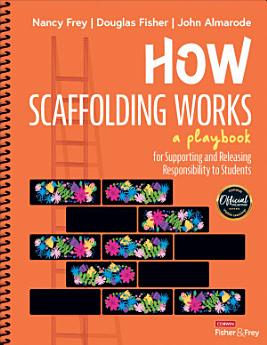
How Scaffolding Works: A Playbook for Supporting and Releasing Responsibility to Students
About this ebook
Effective scaffolding leads to learner autonomy—but too many educators have been airlifting students to right answers, perpetuating a generation who don’t know how to learn. Yes, we know the sweet spot for learning involves giving our students the right blend of productive failure and productive success, but how to do it is cloaked in misconceptions.
How Scaffolding Works unveils the essential moves and methods. Ten interactive modules help every K-12 educator structure support in new ways, including knowing how to:
- Gradually release responsibility to students through intentional and purposeful scaffolding
- Design lessons and experiences that attend to the affective, metacognitive, and cognitive aspects of learning
- Collect data before, during, and after learning, so we can place, move, and take away scaffolds with greater intention
- Promote independence with front-end scaffolds, distributed scaffolds, back-end scaffolds, peer scaffolds, and fading scaffolds
- Use a blend of demonstration, modeling, coaching, explaining, questioning and choice
- Promote purposeful practice—in which learners knows where they’re going and how to get there
Perhaps we rush in to rescue learners because the world seems fraught; we want to help our students reach the safety of academic success. Our intentions are good, but it’s time to step back, gradually and purposefully, and let them pilot their own learning.
Discover more
About the author
Nancy Frey is a professor of educational leadership at San Diego State University and a teacher leader at Health Sciences High and Middle College. Her published titles include The Courage to Learn, The Art and Science of Coaching, How Scaffolding Works, and The Illustrated Guide to Visible Learning. Frey is a credentialed special educator, reading specialist, and administrator in California and learns from teachers and students every day.
Douglas Fisher is a professor and chair of educational leadership at San Diego State University and a teacher leader at Health Sciences High and Middle College. Previously, Fisher was an early intervention teacher and elementary school educator. In 2022, he was inducted into the Reading Hall of Fame by the Literacy Research Association. He has published numerous articles on reading and literacy, leadership, and curriculum design, as well as books such as Your Introduction to PLC+, Welcome to Teaching, How Feedback Works, Teaching Reading, and RIGOR Unveiled. Fisher loves being an educator and hopes to share that passion with others.
John Almarode is a professor of education at James Madison University. He was awarded the inaugural Sarah Miller Luck Endowed Professorship in 2015 and received an Outstanding Faculty Award from the State Council for Higher Education in Virginia in 2021. John started as a mathematics and science teacher in Augusta County, Virginia. John has written multiple books, book chapters, papers, and reports. His collaborative work with colleagues on what works best in teaching and learning includes How Tutoring Works, Visible Learning in Early Childhood, and How Learning Works, all with Corwin Press.