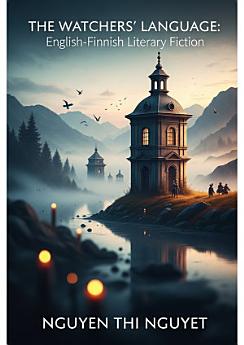
About this ebook
The image of watchers suggests a kind of vigilance, a careful observation. When we read literature in a language not our own, or when we read literature that exists in translation, we become watchers of language. We observe how meaning is constructed, how culture is embedded in words, how the architecture of a language shapes what can be expressed and how it must be expressed. English and Finnish, two languages separated not by simple geographic distance but by fundamental structural difference, offer a particularly illuminating case study for this observation.
Literature is the highest form of language use. In literature, the constraints and possibilities of a language are pushed to their limits. A novelist must decide whether to use the passive voice or active voice, whether to frontload information or reveal it gradually, whether to trust the reader to infer meaning or state it explicitly. These decisions are not merely stylistic preferences; they are constrained and enabled by the language itself. English and Finnish present fundamentally different sets of constraints and possibilities, and thus English literature and Finnish literature, even when addressing similar themes or telling similar stories, will necessarily diverge in their approach, their rhythm, their emotional resonance.
This book examines the literary manifestations of English and Finnish as languages. It is not a work of translation theory, though translation will appear frequently. It is not a work of comparative literature, though we will compare literary works. Rather, it is a work of linguistic literary analysis—the study of how language structures literature, how the choices available in one language differ from the choices available in another, and how these differences are reflected in the actual literary works produced by speakers of these languages.
The Scope and Purpose
The primary audience for this book consists of several overlapping groups. First, there are advanced students of English or Finnish who wish to understand their chosen language at a deeper level by seeing how it is used in literary contexts. Second, there are literature students and scholars interested in understanding how language shapes literary expression. Third, there are translators and translation students who work across the English-Finnish boundary and need to understand not just grammar but the literary implications of linguistic difference. Fourth, there are readers of literature in translation who seek to understand what is gained and lost when a work crosses from one language to another. Finally, there are linguistically curious individuals who understand that language is not a neutral tool but a shaping force on thought, perception, and artistic expression.
Throughout these chapters, we will examine actual literary works, actual passages, actual sentences produced by English and Finnish writers. We will see how the inflectional system of Finnish enables or constrains certain literary effects. We will see how the fixed word order of English creates rhythmic patterns that Finnish, with its more flexible word order, can avoid or embrace differently. We will see how the absence of articles in Finnish creates a kind of opacity or indeterminacy that English, with its mandatory articles, must work to achieve. We will see how the rich case system of Finnish allows for constructions that English must approximate through longer phrases or different syntactic structures.
This is not merely academic analysis. The ultimate purpose of this book is to deepen your understanding of what it means to read, to write, and to think in language. By understanding how English and Finnish differ in their literary manifestations, you will understand more deeply how any language works—including your own.
The Watchers' Perspective
The title "The Watchers' Language" contains an ambiguity worth exploring. It could mean the language of the watchers—the language that watchers use. It could mean the language about watching, observation, perception. But it also suggests a particular stance: the position of the observer, looking in from outside, attempting to understand a phenomenon that one may not fully inhabit.
When we read literature, we are watchers. We stand outside the text and observe its construction. The most sophisticated readers develop a kind of double consciousness: they are absorbed in the narrative, yes, but simultaneously they are aware of the machinery of the narrative—the choices made by the author, the constraints of the language, the effects being produced through specific word choices and syntactic arrangements.
This double consciousness is particularly important when reading literature across linguistic boundaries. An English speaker reading Finnish literature in translation must watch not just the original author but also the translator. The English speaker reading Finnish literature in the original language must watch the foreign language itself, observing how it works, how it differs from English, how these differences shape the literary work.
A writer, too, is a watcher. A writer observes language as it is used, as it might be used, as it could be used differently. A writer pushes against the constraints of language, testing what is possible, what might be expressed in new ways. Finnish writers, working in a language with a rich case system and relative freedom of word order, make different choices than English writers, working in a language with fixed word order and a reliance on prepositions to mark relationships.
This book is written for watchers—for those who are willing to slow down, to observe carefully, to notice the choices made by authors and the constraints within which those choices are made.
Structure and Methodology
The chapters ahead are organized thematically rather than strictly grammatically. We begin with chapters that examine the basic literary effects enabled and constrained by English and Finnish as languages. We move then to chapters that examine specific literary elements: character and voice, narrative structure, dialogue, imagery and symbolism. We then turn to literary movements and styles: modernism, realism, the representation of consciousness, experimental forms. Finally, we examine translation and adaptation, considering how works move between languages and what happens in that movement.
Each chapter is anchored in concrete literary examples. Whenever possible, we examine actual passages from published works, analyzing how the language of the passage creates effects, how the choices made by the author are enabled or constrained by the language, and how the passage might be different if written in the other language.
We also examine theoretical concepts that help us understand how language and literature interact. These concepts come from linguistics, literary theory, translation studies, and narratology. However, the book is written for readers who may not have extensive background in these fields. Technical terms are introduced as needed and explained in accessible language.
English and Finnish Literature: A Brief Historical Context
English literature has a documented tradition stretching back over a thousand years. Old English literature, represented by works like Beowulf, is distant and difficult for modern English speakers to read, yet it remains part of the English literary canon. Middle English literature, represented by Chaucer and others, is more accessible but still requires effort. Early Modern English literature, including Shakespeare and the King James Bible, is the point where English literature becomes readily comprehensible to modern readers. The subsequent centuries have seen an explosion of English literature: the Romantic poets, the Victorian novelists, the Modernists, contemporary authors writing in English today.
This long tradition has shaped English as a literary language. Certain forms, certain approaches to narrative and poetry, have become naturalized in English. English speakers have inherited centuries of literary example and precedent.
This different historical trajectory has implications. English literature developed over a much longer period, allowing for the crystallization of conventions, the establishment of precedents, the development of complex traditions. Finnish literature, while it has deep roots, developed many of its modern forms more recently, sometimes in conscious conversation with European literary movements, sometimes in distinctive Finnish response to universal literary challenges.
Neither trajectory is better or worse. They are simply different, and they have shaped how literature develops in these languages.
The Question of Untranslatability
At the heart of this book lies a question that has troubled translators, linguists, and philosophers for centuries: Can literature be truly translated? Is there something essential to a literary work that is lost when it crosses from one language to another?
But the answer is also no, complete loss does not occur. Meaning can be preserved or approximated. New effects can be created in the target language that, while different from the original effects, are nevertheless powerful and literary. A poem may lose its original rhyme scheme but gain new structural properties in the target language.
The truth is more nuanced: literature, like language itself, is partly translatable and partly untranslatable. Some aspects of literary meaning are language-specific and cannot be transferred. Other aspects are language-universal and transfer readily. Most literary works exist in a middle ground: some meanings transfer, others must be approximated, still others are lost, and new meanings may be created in the process.
This book takes the position that the areas of untranslatability—the meanings that cannot be transferred—are precisely the places where language reveals itself most clearly as a shaping force on literature. By understanding what is lost in translation, we understand what is essential to the original language's literary tradition.
Reading This Book
This book is designed to be read sequentially, with each chapter building on previous chapters. However, readers may also turn to specific chapters that address their particular interests.
Throughout the book, you will encounter passages in both English and Finnish. You do not need to be fluent in either language to benefit from the analysis. Translations and explanations are provided. However, if you do have knowledge of either language, you will benefit from consulting the original passages and considering the analysis in light of your own understanding.
You will also be invited to conduct your own close reading exercises. These exercises ask you to examine a passage yourself before reading the analysis provided. The point is not to reach the "correct" answer but to develop your own capacity for observation and analysis.
Finally, you will encounter reflection questions at the end of each chapter. These questions are designed to deepen your thinking and to encourage you to apply the concepts discussed to other literary works you may know.
The journey ahead is a journey into language, into literature, and into the intricate relationship between the two. It is a journey that requires patience, attention, and a willingness to slow down and observe carefully. But it is a journey worth taking, for in understanding how language shapes literature, we come to understand literature more deeply, language more completely, and ourselves as readers and thinkers more fully.
Let us begin by observing the watchers' language in action.
About the author
Nguyen Thi Nguyet is a visionary writer and artist who crafts narratives at the intersection of language, memory, and power. Drawing from a deep engagement with bilingual expression and the haunting traditions of folktale and bureaucratic gothic, she constructs immersive literary worlds that challenge and unsettle. Her work often explores themes of identity, systemic control, and the psychological landscapes of those living under watchful regimes.
In PRACTICAL, she merges English and Finnish into a unique dual-voice narrative, reflecting her commitment to linguistic authenticity and emotional depth. When not writing, she is also involved in book design and visual art, ensuring each project is a cohesive aesthetic and intellectual experience.
Nguyen Thi Nguyet continues to explore the silent spaces between words and worlds, inviting readers to journey with her into the unseen territories of the human condition.