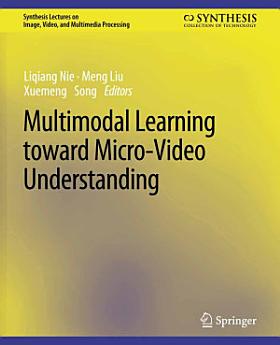
Multimodal Learning toward Micro-Video Understanding
2022年5月 · Springer Nature
star
1 条评价
电子书
170
页
关于此电子书
Micro-videos, a new form of user-generated contents, have been spreading widely across various social platforms, such as Vine, Kuaishou, and Tik Tok. Different from traditional long videos, micro-videos are usually recorded by smart mobile devices at any place within a few seconds. Due to its brevity and low bandwidth cost, micro-videos are gaining increasing user enthusiasm. The blossoming of micro-videos opens the door to the possibility of many promising applications, ranging from network content caching to online advertising. Thus, it is highly desirable to develop an effective scheme for the high-order micro-video understanding. Micro-video understanding is, however, non-trivial due to the following challenges: (1) how to represent micro-videos that only convey one or few high-level themes or concepts; (2) how to utilize the hierarchical structure of the venue categories to guide the micro-video analysis; (3) how to alleviate the influence of low-quality caused by complex surrounding environments and the camera shake; (4) how to model the multimodal sequential data, {i.e.}, textual, acoustic, visual, and social modalities, to enhance the micro-video understanding; and (5) how to construct large-scale benchmark datasets for the analysis? These challenges have been largely unexplored to date. In this book, we focus on addressing the challenges presented above by proposing some state-of-the-art multimodal learning theories. To demonstrate the effectiveness of these models, we apply them to three practical tasks of micro-video understanding: popularity prediction, venue category estimation, and micro-video routing. Particularly, we first build three large-scale real-world micro-video datasets for these practical tasks. We then present a multimodal transductive learning framework for micro-video popularity prediction. Furthermore, we introduce several multimodal cooperative learning approaches and a multimodal transfer learning scheme for micro-video venue category estimation. Meanwhile, we develop a multimodal sequential learning approach for micro-video recommendation. Finally, we conclude the book and figure out the future research directions in multimodal learning toward micro-video understanding.
Micro-videos, a new form of user-generated contents, have been spreading widely across various social platforms, such as Vine, Kuaishou, and Tik Tok. Different from traditional long videos, micro-videos are usually recorded by smart mobile devices at any place within a few seconds. Due to its bre...
探索更多
评分和评价
1 条评价
作者简介
Liqiang Nie is currently a professor with the School of Computer Science and Technology, Shandong University. In addition, he is the adjunct dean with the Shandong AI institute.H e received his B.Eng. and Ph.D. from Xian Jiaotong University in 2009 and the National University of Singapore (NUS) in 2013, respectively. After his Ph.D., Dr. Nie continued his research in NUS as a research fellow for three and half years. His research interests lie primarily in multimedia computing and information retrieval. Dr. Nie has authored and/or coauthored more than 100 papers for SIGIR, ACM MM, TOIS,and TIP, received more than 4,800 Google Scholar citations. He is an AE of Information Science, and an area chair of ACMMM 2018/2019.Meng Liu is currently a Ph.D. student with the School of Computing Science and Technology, Shandong University. She received an M.S. in computational mathematics from Dalian University of Technology, China in 2016. Her research interests are multimedia computing and information retrieval. Various parts of her work have been published in top forums and journals, such as SIGIR, MM, and IEEE TIP. She has served as reviewer and subreviewer for various conferences and journals, such as MMM, MM, PCM, JVCI, and INS.Xuemeng Song received a B.E. from the University of Science and Technology of China in 2012, and a Ph.D. from the School of Computing, National University of Singapore in 2016. She is currently an assistant professor of Shandong University, Jinan, China. Her research interests include information retrieval and social network analysis. She has published several papers in the top venues, such as ACM SIGIR, MM,and TOIS. In addition, she has served as a reviewer for many top conferences and journals.
Liqiang Nie is currently a professor with the School of Computer Science and Technology, Shandong University. In addition, he is the adjunct dean with the Shandong AI institute.H e received his B.Eng. and Ph.D. from Xian Jiaotong University in 2009 and the National University of Singapore (NUS) i...
为此电子书评分
欢迎向我们提供反馈意见。
如何阅读
智能手机和平板电脑
笔记本电脑和台式机
您可以使用计算机的网络浏览器聆听您在 Google Play 购买的有声读物。
电子阅读器和其他设备
如果要在 Kobo 电子阅读器等电子墨水屏设备上阅读,您需要下载一个文件,并将其传输到相应设备上。若要将文件传输到受支持的电子阅读器上,请按帮助中心内的详细说明操作。