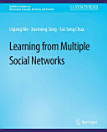
Multimodal Learning toward Micro-Video Understanding
mai 2022 · Springer Nature
star
O recenzie
Carte electronică
170
Pagini
Despre această carte electronică
Micro-videos, a new form of user-generated contents, have been spreading widely across various social platforms, such as Vine, Kuaishou, and Tik Tok. Different from traditional long videos, micro-videos are usually recorded by smart mobile devices at any place within a few seconds. Due to its brevity and low bandwidth cost, micro-videos are gaining increasing user enthusiasm. The blossoming of micro-videos opens the door to the possibility of many promising applications, ranging from network content caching to online advertising. Thus, it is highly desirable to develop an effective scheme for the high-order micro-video understanding. Micro-video understanding is, however, non-trivial due to the following challenges: (1) how to represent micro-videos that only convey one or few high-level themes or concepts; (2) how to utilize the hierarchical structure of the venue categories to guide the micro-video analysis; (3) how to alleviate the influence of low-quality caused by complex surrounding environments and the camera shake; (4) how to model the multimodal sequential data, {i.e.}, textual, acoustic, visual, and social modalities, to enhance the micro-video understanding; and (5) how to construct large-scale benchmark datasets for the analysis? These challenges have been largely unexplored to date. In this book, we focus on addressing the challenges presented above by proposing some state-of-the-art multimodal learning theories. To demonstrate the effectiveness of these models, we apply them to three practical tasks of micro-video understanding: popularity prediction, venue category estimation, and micro-video routing. Particularly, we first build three large-scale real-world micro-video datasets for these practical tasks. We then present a multimodal transductive learning framework for micro-video popularity prediction. Furthermore, we introduce several multimodal cooperative learning approaches and a multimodal transfer learning scheme for micro-video venue category estimation. Meanwhile, we develop a multimodal sequential learning approach for micro-video recommendation. Finally, we conclude the book and figure out the future research directions in multimodal learning toward micro-video understanding.
Micro-videos, a new form of user-generated contents, have been spreading widely across various social platforms, such as Vine, Kuaishou, and Tik Tok. Different from traditional long videos, micro-videos are usually recorded by smart mobile devices at any place within a few seconds. Due to its bre...
Descoperă mai multe
Evaluări și recenzii
O recenzie
Despre autor
Liqiang Nie is currently a professor with the School of Computer Science and Technology, Shandong University. In addition, he is the adjunct dean with the Shandong AI institute.H e received his B.Eng. and Ph.D. from Xian Jiaotong University in 2009 and the National University of Singapore (NUS) in 2013, respectively. After his Ph.D., Dr. Nie continued his research in NUS as a research fellow for three and half years. His research interests lie primarily in multimedia computing and information retrieval. Dr. Nie has authored and/or coauthored more than 100 papers for SIGIR, ACM MM, TOIS,and TIP, received more than 4,800 Google Scholar citations. He is an AE of Information Science, and an area chair of ACMMM 2018/2019.Meng Liu is currently a Ph.D. student with the School of Computing Science and Technology, Shandong University. She received an M.S. in computational mathematics from Dalian University of Technology, China in 2016. Her research interests are multimedia computing and information retrieval. Various parts of her work have been published in top forums and journals, such as SIGIR, MM, and IEEE TIP. She has served as reviewer and subreviewer for various conferences and journals, such as MMM, MM, PCM, JVCI, and INS.Xuemeng Song received a B.E. from the University of Science and Technology of China in 2012, and a Ph.D. from the School of Computing, National University of Singapore in 2016. She is currently an assistant professor of Shandong University, Jinan, China. Her research interests include information retrieval and social network analysis. She has published several papers in the top venues, such as ACM SIGIR, MM,and TOIS. In addition, she has served as a reviewer for many top conferences and journals.
Liqiang Nie is currently a professor with the School of Computer Science and Technology, Shandong University. In addition, he is the adjunct dean with the Shandong AI institute.H e received his B.Eng. and Ph.D. from Xian Jiaotong University in 2009 and the National University of Singapore (NUS) i...
Evaluează cartea electronică
Spune-ne ce crezi.
Informații despre lectură
Smartphone-uri și tablete
Instalează aplicația Cărți Google Play pentru Android și iPad/iPhone. Se sincronizează automat cu contul tău și poți să citești online sau offline de oriunde te afli.
Laptopuri și computere
Poți să asculți cărțile audio achiziționate pe Google Play folosind browserul web al computerului.
Dispozitive eReader și alte dispozitive
Ca să citești pe dispozitive pentru citit cărți electronice, cum ar fi eReaderul Kobo, trebuie să descarci un fișier și să îl transferi pe dispozitiv. Urmează instrucțiunile detaliate din Centrul de ajutor pentru a transfera fișiere pe dispozitivele eReader compatibile.