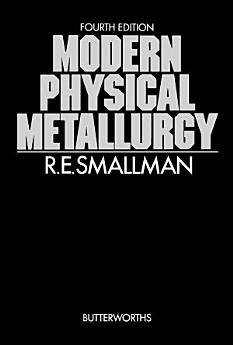
Modern Physical Metallurgy: Edition 4
juin 2016 · Elsevier
E-book
544
Pages
family_home
Éligible
info
À propos de cet e-book
Modern Physical Metallurgy, Fourth Edition discusses the fundamentals and applications of physical metallurgy. The book is comprised of 15 chapters that cover the experimental background of a metallurgical phenomenon. The text first talks about the structure of atoms and crystals, and then proceeds to dealing with the physical examination of metals and alloys. The third chapter tackles the phase diagrams and solidifications, while the fourth chapter covers the thermodynamics of crystals. Next, the book discusses the structure of alloys. The next four chapters deal with the deformations and defects of crystals, metals, and alloys. Chapter 10 discusses work hardening and annealing, while Chapters 11 and 12 cover phase transformations. The succeeding two chapters talk about creep, fatigue, and fracture, while the last chapter covers oxidation and corrosion. The text will be of great use to undergraduate students of materials engineering and other degrees that deal with metallurgical properties.
Modern Physical Metallurgy, Fourth Edition discusses the fundamentals and applications of physical metallurgy. The book is comprised of 15 chapters that cover the experimental background of a metallurgical phenomenon. The text first talks about the structure of atoms and crystals, and then procee...
En voir d'autres
À propos de l'auteur
After gaining his PhD in 1953, Professor Smallman spent five years at the Atomic Energy ResearchEstablishment at Harwell before returning to the University of Birmingham, where he became Professorof Physical Metallurgy in 1964 and Feeney Professor and Head of the Department of PhysicalMetallurgy and Science of Materials in 1969. He subsequently became Head of the amalgamatedDepartment of Metallurgy and Materials (1981), Dean of the Faculty of Science and Engineering, andthe first Dean of the newly created Engineering Faculty in 1985. For five years he wasVice-Principalof the University (1987-92).He has held visiting professorship appointments at the University of Stanford, Berkeley, Pennsylvania(USA), New SouthWales (Australia), Hong Kong and Cape Town, and has received HonoraryDoctorates from the University of Novi Sad (Yugoslavia), University ofWales and Cranfield University.His research work has been recognized by the award of the Sir George Beilby Gold Medal of theRoyal Institute of Chemistry and Institute of Metals (1969), the Rosenhain Medal of the Institute ofMetals for contributions to Physical Metallurgy (1972), the Platinum Medal, the premier medal ofthe Institute of Materials (1989), and the Acta Materialia Gold Medal (2004).Hewas elected a Fellowof the Royal Society (1986), a Fellowof the RoyalAcademy of Engineering(1990), a Foreign Associate of the United States National Academy of Engineering (2005), andappointed a Commander of the British Empire (CBE) in 1992. A former Council Member of theScience and Engineering Research Council, he has been Vice-President of the Institute of Materialsand President of the Federated European Materials Societies. Since retirement he has been academicconsultant for a number of institutions both in the UK and overseas.
After gaining his PhD in 1953, Professor Smallman spent five years at the Atomic Energy ResearchEstablishment at Harwell before returning to the University of Birmingham, where he became Professorof Physical Metallurgy in 1964 and Feeney Professor and Head of the Department of PhysicalMetallurgy ...
Donner une note à cet e-book
Dites-nous ce que vous en pensez.
Informations sur la lecture
Smartphones et tablettes
Installez l'application Google Play Livres pour Android et iPad ou iPhone. Elle se synchronise automatiquement avec votre compte et vous permet de lire des livres en ligne ou hors connexion, où que vous soyez.
Ordinateurs portables et de bureau
Vous pouvez écouter les livres audio achetés sur Google Play à l'aide du navigateur Web de votre ordinateur.
Liseuses et autres appareils
Pour lire sur des appareils e-Ink, comme les liseuses Kobo, vous devez télécharger un fichier et le transférer sur l'appareil en question. Suivez les instructions détaillées du Centre d'aide pour transférer les fichiers sur les liseuses compatibles.