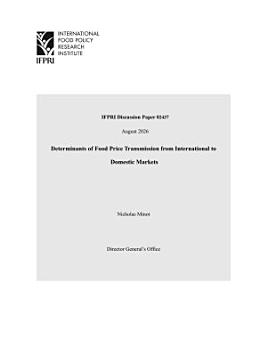
Determinants of food price transmission from international to domestic markets
Minot, Nicholas
Aug 2026 · IFPRI Discussion Paper Book 2437 · International Food Policy Research Institute
Ebook
46
Pages
family_home
Eligible
info
About this ebook
Food price transmission determines the speed of and extent to which international food price shocks affect domestic markets and consumers, an issue of particular importance in low-income countries. Incomplete food price transmission is also implicated in exacerbating international food price volatility because it makes global supply and demand less elastic. This paper explores the factors that influence the degree of price transmission from international maize, rice, and wheat markets to domestic food markets. Using 147,000 observations of monthly food prices, we first estimate food price transmission in 711 markets in 81 countries. Then, the degree of food price transmission across these 711 markets is estimated as a function of country and commodity characteristics. The results from the first stage indicate that about half (48%) of the domestic food prices were cointegrated with their corresponding international grain price. Among the vector error correction (VEC) models, the median price transmission is 52% after 6 months and 69% after 12 months. Among the vector autoregressive (VAR) models, price transmission was markedly lower, with the median leveling off below 7% after four months. The second-stage results suggest that both market frictions and policy play a role in incomplete transmission of food prices. Food price transmission is significantly lower in landlocked countries, where grain imports or exports are a small share of domestic use, and in Africa and Asia relative to Europe and Latin America. Price transmission is also lower where grain tariffs are high and variable over time, suggesting that trade policy plays a role. These results appear relatively robust, with only minor changes when we estimate the model with different dependent variables, other combinations of independent variables, different thresholds for the stationarity tests, and alternative cointegration tests. The results have implications for the measurement of the welfare impact of international food price shocks and for strategies to reduce the volatility of international grain prices.
Food price transmission determines the speed of and extent to which international food price shocks affect domestic markets and consumers, an issue of particular importance in low-income countries. Incomplete food price transmission is also implicated in exacerbating international food price vola...
Discover more
Rate this ebook
Tell us what you think.
Reading information
Smartphones and tablets
Install the Google Play Books app for Android and iPad/iPhone. It syncs automatically with your account and allows you to read online or offline wherever you are.
Laptops and computers
You can listen to audiobooks purchased on Google Play using your computer's web browser.
eReaders and other devices
To read on e-ink devices like Kobo eReaders, you'll need to download a file and transfer it to your device. Follow the detailed Help Center instructions to transfer the files to supported eReaders.