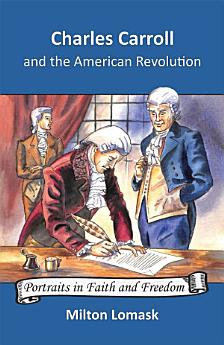
Charles Carroll and the American Revolution
About this ebook
Includes a useful Author’s Note
Historical Insight by Daria Sockey
Discover more
About the author
Milton N. Lomask, born in West Virginia in the first decade of the twentieth century, spent all his growing-up years in a small town in Iowa. As the only son of an early-widowed mother, he found the company of his maternal grandfather, an exceptional man, “was enough for a dozen lads.” His grandfather, he recalls, was his role model, an inseparable companion until his death when Milton was 16, and “in all those years I never saw him do a mean or cowardly thing, nor did I ever hear him say an unkind word about another human being.” (The Book of Catholic Authors, vol 6)
Milton studied journalism at the University of Iowa. He obtained work on a small newspaper in Texas, and in the next few years, had editorial stints from Des Moines to St Louis to New York to Chicago. Just after earning a Master of Arts degree from Northwestern University, World War II interrupted his plans. Lomask served four years as a captain in the army. When the war was over, and now in New York City, Lomask worked in advertising and publicity management, while in his free time he wrote magazine articles and plays. By 1950 he felt ready to venture into full-time writing and teaching on his own.
Meanwhile in the religious sphere Lomask had crossed into new territory. Born into a Jewish family but living in a town with no synagogue, Milton’s formal religious instruction had been minimal. Religion didn’t seem important to him as an adult. But when he was given a newspaper job in 1939 to write an abstract of Pius XII’s first encyclical, he became interested. “Perhaps it was the Holy Father’s carefully-reasoned condemnation of dictatorship at a time when so many of my people, the Jews, were suffering under Hitler in Germany.” Lomask began to read Catholic literature and sometimes attended Mass. In 1949 he was received into the Catholic Church.
Not long after Lomask became self-employed, in addition to college teaching, he began writing books based on his history research, some for adults (Andrew Johnson: President on Trial was a History Book Selection in 1960)—and many for children and youth. Over twenty books for young people, mostly biographies, would come from his pen. Charles Carroll and the American Revolution was originally written for American Background Books, a series aimed at presenting, for older youth, outstanding Catholics from every walk of life. When friends teased Lomask that he enjoyed writing for children because he was childish, his reply was that although that might be so, his books were successful “in spite of it,” saying:
Books for children should not be childish because they are not directed to childish readers. . .Children like their history straight and their fiction believable and thoughtful. The many letters I get from them tell me that on this point the younger generation and this childish grown-up see eye to eye.
Lomask had some plays produced earlier in his career—and a dramatist’s flair for dialog and well-rounded characterization served him well in his biographies. Above all, perhaps a major source of Lomask’s success with children’s biographies goes back to that grandfather who knew how to meet the child Milton on his own ground.
Milton Lomask died in 1991 at the age of 82.