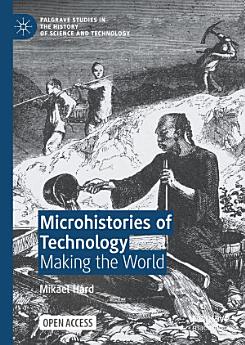
Microhistories of Technology: Making the World
Mikael Hård
Feb 2023 · Springer Nature
Ebook
290
Pages
About this ebook
In this open access book, Mikael Hård tells a story of how people around the world challenged the production techniques and products brought by globalization. Retaining their autonomy and freedom, creative individuals selectively adopted or rejected modern gadgets, tools, and machines. In standard historical narratives, globalization is portrayed as an unstoppable force that flattens all obstacles in its path. Modern technology is also seen as inexorable: in the nineteenth century, steamships, telegraph lines, and Gatling guns are said to have paved the way for colonialism and other forms of dominating people and societies. Later, shipping containers and computer networks purportedly pulled the planet deeper into a maelstrom of capitalism. Hård discusses instances that push back against these narratives. For example, in Soviet times, inhabitants of Samarkand, Uzbekistan, preferred to remain in—and expand—their own mud-brick houses rather than move into prefabricated, concreteresidential buildings. Similarly, nineteenth-century Sumatran carpenters ignored the saws brought to them by missionaries—and chose to chop down trees with their arch-bladed adzes. And people in colonial India successfully competed with capitalist-run Caribbean sugar plantations, continuing to produce their own muscovado and sell it to local consumers. This book invites readers to view the history of technology and material culture through the lens of diversity. Based on research funded by the European Research Council and conducted in the Global South, Microhistories of Technology: Making the World shows that the spread of modern technologies did not erase artisanal production methods and traditional tools.
In this open access book, Mikael Hård tells a story of how people around the world challenged the production techniques and products brought by globalization. Retaining their autonomy and freedom, creative individuals selectively adopted or rejected modern gadgets, tools, and machines. In standar...
Discover more
About the author
Mikael Hård is Professor of History of Technology at the Technical University of Darmstadt, Germany.
Mikael Hård is Professor of History of Technology at the Technical University of Darmstadt, Germany.
Rate this ebook
Tell us what you think.
Reading information
Smartphones and tablets
Install the Google Play Books app for Android and iPad/iPhone. It syncs automatically with your account and allows you to read online or offline wherever you are.
Laptops and computers
You can listen to audiobooks purchased on Google Play using your computer's web browser.
eReaders and other devices
To read on e-ink devices like Kobo eReaders, you'll need to download a file and transfer it to your device. Follow the detailed Help Center instructions to transfer the files to supported eReaders.