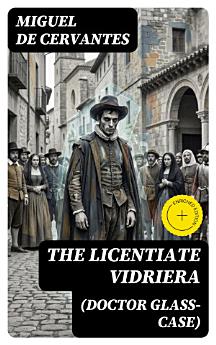
The Licentiate Vidriera (Doctor Glass-Case) (Annotated): Enriched Edition. A Spanish Golden Age Satire of Madness, Identity, and Society's Fragile Perceptions
Sep 2022 · DigiCat
Ebook
26
Pages
family_home
Eligible
info
About this ebook
In "The Licentiate Vidriera," one of Miguel de Cervantes's Exemplary Novels (1613), the learned Tomás Rodaja becomes convinced that his body is made of glass after an illness and thereafter speaks with startling freedom under the name Licentiate Vidriera. His delusion supplies the novella's governing metaphor: social reality appears fragile, transparent, and dangerously penetrable, while madness paradoxically grants access to truths that conventional reason suppresses. Combining comic anecdote, sharp aphorism, university satire, travel narrative, and the dialogic energy of the picaresque tradition, Cervantes tests the boundaries between wisdom and folly, performance and identity, and moral instruction and entertainment. The work belongs to Spain's Golden Age prose culture, yet its skepticism toward fixed authority and its interest in self-fashioning anticipate the modern novel's psychological and epistemological concerns. Cervantes (1547–1616), soldier, captive, tax collector, and author of Don Quixote, wrote from a lifetime of encounters with unstable institutions and rigid social hierarchies. His experience of poverty, imprisonment, and literary competition informed his recurring fascination with outsiders whose eccentric perspectives expose communal hypocrisy. The novella's learned protagonist reflects Cervantes's own sustained engagement with education, literary authority, and the precarious status of intellectuals in early modern Spain. This concise, richly layered work is especially rewarding for readers interested in Renaissance humanism, the history of madness, and the development of European fiction. Its brilliant verbal wit makes it accessible, while its ethical and philosophical ambiguities invite sustained scholarly reflection. This enriched edition has been carefully crafted to add value to your reading experience. - A succinct Introduction situates the work's timeless appeal and themes. - The Synopsis outlines the central plot, highlighting key developments without spoiling critical twists. - A detailed Historical Context immerses you in the era's events and influences that shaped the writing. - An Author Biography reveals milestones in the author's life, illuminating the personal insights behind the text. - A thorough Analysis dissects symbols, motifs, and character arcs to unearth underlying meanings. - Reflection questions prompt you to engage personally with the work's messages, connecting them to modern life. - Hand‐picked Memorable Quotes shine a spotlight on moments of literary brilliance. - Interactive footnotes clarify unusual references, historical allusions, and archaic phrases for an effortless, more informed read.
In "The Licentiate Vidriera," one of Miguel de Cervantes's Exemplary Novels (1613), the learned Tomás Rodaja becomes convinced that his body is made of glass after an illness and thereafter speaks with startling freedom under the name Licentiate Vidriera. His delusion supplies the novella's gover...
Discover more
About the author
Miguel de Cervantes Saavedra (1547–1616) is universally recognized as one of the greatest literary figures of all time, often referred to as the father of the modern novel. A man whose life was as rich in adventure as in literature, Cervantes was born in Alcalá de Henares, Spain, and among his extensive oeuvre, he is most renowned for 'Don Quixote,' a work that has been heralded as the first modern novel. 'The Licentiate Vidriera,' or 'Doctor Glass-Case,' adds to Cervantes' exemplary collection of novellas known as 'Exemplary Novels' (1613), a series which showcases his narrative prowess and his keen ability to intertwine reality and imagination (Cervantes, 1613). In this particular novella, he explores themes of sanity, social criticism, and the fleeting nature of human judgment, all conveyed with a characteristic blend of pathos and humor. Cervantes' works are celebrated for their rich characterization, inventive plots, and deep humanity, reflecting his capacity to traverse both the idealistic and the ironic, the comedic and the tragic. Cervantes' literary influence is evident in the development of the novel as an art form, and his insightful social commentary continues to remain relevant centuries after his death. Acknowledged by critics and scholars alike, Cervantes' transformative impact on literature is immutable, and his works remain a cornerstone in the study of narrative art and Western literature.
Miguel de Cervantes Saavedra (1547–1616) is universally recognized as one of the greatest literary figures of all time, often referred to as the father of the modern novel. A man whose life was as rich in adventure as in literature, Cervantes was born in Alcalá de Henares, Spain, and among his ex...
Rate this ebook
Tell us what you think.
Reading information
Smartphones and tablets
Install the Google Play Books app for Android and iPad/iPhone. It syncs automatically with your account and allows you to read online or offline wherever you are.
Laptops and computers
You can listen to audiobooks purchased on Google Play using your computer's web browser.
eReaders and other devices
To read on e-ink devices like Kobo eReaders, you'll need to download a file and transfer it to your device. Follow the detailed Help Center instructions to transfer the files to supported eReaders.