Kuhusu kitabu pepe hiki
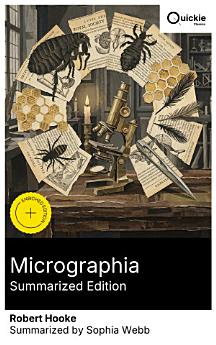
Micrographia (1665) opens a vast new world by recording, in crystalline prose and sumptuous copperplates, the textures and structures of minute bodies—flea and louse, bee-sting and feather, mold, needle point, and the honeycombed cork in which Hooke first named the 'cells.' Organized as a sequence of observations with reflective 'Inquiries,' the book marries measurement with speculation, and sets the Baconian ideal of experiment within the visual rhetoric of the Scientific Revolution. Its dramatic fold-out plates and patient, calibrated descriptions forged a language and iconography for early microscopy. Robert Hooke, polymath Curator of Experiments to the nascent Royal Society and longtime collaborator of Robert Boyle, brought to this work a craftsman's intimacy with instruments and a philosopher's appetite for causes. His refinements in lenses and illumination, his habit of daily experiments, and his duty to stage public demonstrations all fed the project; so too did his draughtsman's hand, which translated observation into authoritative image and argument. Readers of science, art, and intellectual history will find Micrographia indispensable: a foundational statement of modern empiricism and a gallery of the unseen. Approach it to witness method at work, to savor disciplined wonder, and to grasp how tools and images re-make knowledge. Quickie Classics summarizes timeless works with precision, preserving the author's voice and keeping the prose clear, fast, and readable—distilled, never diluted. Enriched Edition extras: Introduction · Synopsis · Historical Context · Author Biography · Brief Analysis · 4 Reflection Q&As · Editorial Footnotes.
Micrographia (1665) opens a vast new world by recording, in crystalline prose and sumptuous copperplates, the textures and structures of minute bodies—flea and louse, bee-sting and feather, mold, needle point, and the honeycombed cork in which Hooke first named the 'cells.' Organized as a sequenc...
Gundua zaidi
Kadiria kitabu pepe hiki
Tupe maoni yako.
Kusoma maelezo
Simu mahiri na kompyuta vibao
Sakinisha programu ya Vitabu vya Google Play kwa ajili ya Android na iPad au iPhone. Itasawazishwa kiotomatiki kwenye akaunti yako na kukuruhusu usome vitabu mtandaoni au nje ya mtandao popote ulipo.
Kompyuta za kupakata na kompyuta
Unaweza kusikiliza vitabu vilivyonunuliwa kwenye Google Play wakati unatumia kivinjari cha kompyuta yako.
Visomaji pepe na vifaa vingine
Ili usome kwenye vifaa vya wino pepe kama vile visomaji vya vitabu pepe vya Kobo, utahitaji kupakua faili kisha ulihamishie kwenye kifaa chako. Fuatilia maagizo ya kina ya Kituo cha Usaidizi ili uhamishe faili kwenye visomaji vya vitabu pepe vinavyotumika.