Om den här e-boken
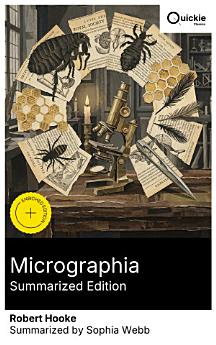
Micrographia (1665) opens a vast new world by recording, in crystalline prose and sumptuous copperplates, the textures and structures of minute bodies—flea and louse, bee-sting and feather, mold, needle point, and the honeycombed cork in which Hooke first named the 'cells.' Organized as a sequence of observations with reflective 'Inquiries,' the book marries measurement with speculation, and sets the Baconian ideal of experiment within the visual rhetoric of the Scientific Revolution. Its dramatic fold-out plates and patient, calibrated descriptions forged a language and iconography for early microscopy. Robert Hooke, polymath Curator of Experiments to the nascent Royal Society and longtime collaborator of Robert Boyle, brought to this work a craftsman's intimacy with instruments and a philosopher's appetite for causes. His refinements in lenses and illumination, his habit of daily experiments, and his duty to stage public demonstrations all fed the project; so too did his draughtsman's hand, which translated observation into authoritative image and argument. Readers of science, art, and intellectual history will find Micrographia indispensable: a foundational statement of modern empiricism and a gallery of the unseen. Approach it to witness method at work, to savor disciplined wonder, and to grasp how tools and images re-make knowledge. Quickie Classics summarizes timeless works with precision, preserving the author's voice and keeping the prose clear, fast, and readable—distilled, never diluted. Enriched Edition extras: Introduction · Synopsis · Historical Context · Author Biography · Brief Analysis · 4 Reflection Q&As · Editorial Footnotes.
Micrographia (1665) opens a vast new world by recording, in crystalline prose and sumptuous copperplates, the textures and structures of minute bodies—flea and louse, bee-sting and feather, mold, needle point, and the honeycombed cork in which Hooke first named the 'cells.' Organized as a sequenc...
Upptäck mer
Betygsätt e-boken
Berätta vad du tycker.
Läsinformation
Smartphones och surfplattor
Installera appen Google Play Böcker för Android och iPad/iPhone. Appen synkroniseras automatiskt med ditt konto så att du kan läsa online eller offline var du än befinner dig.
Laptops och stationära datorer
Du kan lyssna på ljudböcker som du har köpt på Google Play via webbläsaren på datorn.
Läsplattor och andra enheter
Om du vill läsa boken på enheter med e-bläck, till exempel Kobo-läsplattor, måste du ladda ned en fil och överföra den till enheten. Följ anvisningarna i hjälpcentret om du vill överföra filerna till en kompatibel läsplatta.