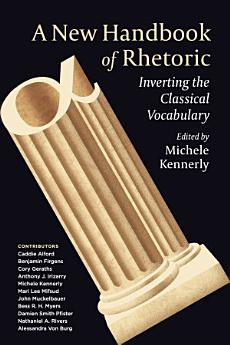
A New Handbook of Rhetoric: Inverting the Classical Vocabulary

· Penn State Press
Ebook
224
Pages
Tools
Eligible

About this ebook

Like every discipline, Rhetorical Studies relies on a technical vocabulary to convey specialized concepts, but few disciplines rely so deeply on a set of terms developed so long ago. Pathos, kairos, doxa, topos—these and others originate from the so-called classical world, which has conferred on them excessive authority. Without jettisoning these rhetorical terms altogether, this handbook addresses critiques of their ongoing relevance, explanatory power, and exclusionary effects.

A New Handbook of Rhetoric inverts the terms of classical rhetoric by applying to them the alpha privative, a prefix that expresses absence. Adding the prefix α- to more than a dozen of the most important terms in the field, the contributors to this volume build a new vocabulary for rhetorical inquiry. Essays on apathy, akairos, adoxa, and atopos, among others, explore long-standing disciplinary habits, reveal the denials and privileges inherent in traditional rhetorical inquiry, and theorize new problems and methods. Using this vocabulary in an analysis of current politics, media, and technology, the essays illuminate aspects of contemporary culture that traditional rhetorical theory often overlooks.

Innovative and groundbreaking, A New Handbook of Rhetoric at once draws on and unsettles ancient Greek rhetorical terms, opening new avenues for studying values, norms, and phenomena often stymied by the tradition.

In addition to the editor, the contributors include Caddie Alford, Benjamin Firgens, Cory Geraths, Anthony J. Irizarry, Mari Lee Mifsud, John Muckelbauer, Bess R. H. Myers, Damien Smith Pfister, Nathaniel A. Rivers, and Alessandra Von Burg.

Like every discipline, Rhetorical Studies relies on a technical vocabulary to convey specialized concepts, but few disciplines rely so deeply on a set of terms developed so long ago. Pathos, kairos, doxa, topos—these and others originate from the so-called classical world, which has conferred on ...

Discover more

About the author

Michele Kennerly is Associate Professor of Communication Arts and Sciences and Classics and Ancient Mediterranean Studies at Penn State University.

Michele Kennerly is Associate Professor of Communication Arts and Sciences and Classics and Ancient Mediterranean Studies at Penn State University.

Rate this ebook

Tell us what you think.

Reading information

Smartphones and tablets
Install the Google Play Books app for Android and iPad/iPhone. It syncs automatically with your account and allows you to read online or offline wherever you are.
Laptops and computers
You can listen to audiobooks purchased on Google Play using your computer's web browser.
eReaders and other devices
To read on e-ink devices like Kobo eReaders, you'll need to download a file and transfer it to your device. Follow the detailed Help Center instructions to transfer the files to supported eReaders.