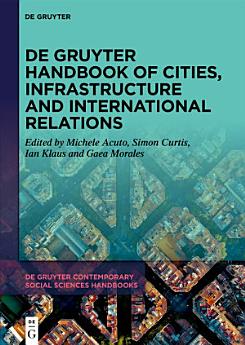
De Gruyter Handbook of Cities, Infrastructure and International Relations

· · ·
· Walter de Gruyter GmbH & Co KG
Ebook
470
Pages
Tools

About this ebook

Cities have been the motive force of globalisation. As cities have grown to sizes unknown in the historical record, they very often dwarf many states in terms of population and economic power, placing our frameworks for understanding the international system under strain. Cities have increasingly tried, often successfully, to translate their new-found heft and economic might into political power – in the halls of international organisations, in the United Nations system, and also through the many hundreds of transnational networks that are having real influence on global governance issues and outcomes in areas such as climate change, migration, global health, and disaster risk management.

This volume argues that cities and infrastructures of connectivity – including transportation, digital architectures, computational stacks, and energy infrastructures – are also important components of international order itself – objects and mediums of geopolitical competition. The ‘global’ cities that have emerged in the current round of globalisation are not simply urban phenomena, but have been dependent upon the liberal international order and the powerful states that underpinned it for the international environment in which they were able to thrive – and have in turn underpinned that order. With the rise of China and its immensely ambitious Belt and Road Initiative, we have seen once again this intrinsic connection between geopolitical power and infrastructure and urbanism, as great powers make cities and their connecting infrastructures a central plank of an emerging contestation over the shape of the twenty-first century.

This volume assesses the emergence of global cities and their continuing evolution within the international system, and the ways in which such cities challenge our existing understandings of diplomacy, territoriality, sovereignty, legitimacy, international law and agency. Also, importantly, this handbook considers the growing importance of understanding global infrastructures in the twenty-first century, and how they are a little understood and yet critical aspect of international order and competition.

Cities have been the motive force of globalisation. As cities have grown to sizes unknown in the historical record, they very often dwarf many states in terms of population and economic power, placing our frameworks for understanding the international system under strain. Cities have increasingly...

About the author

Michele Acuto, U of Bristol.

Simon Curtis, U of Surrey.

Ian Klaus, Carnegie Endowment for International Peace.

Gaea Morales, Loyola University Chicago.
Michele Acuto, U of Bristol. Simon Curtis, U of Surrey. Ian Klaus, Carnegie Endowment for International Peace. Gaea Morales, Loyola University Chicago.
Rate this ebook

Tell us what you think.

Reading information

Smartphones and tablets
Install the Google Play Books app for Android and iPad/iPhone. It syncs automatically with your account and allows you to read online or offline wherever you are.
Laptops and computers
You can listen to audiobooks purchased on Google Play using your computer's web browser.
eReaders and other devices
To read on e-ink devices like Kobo eReaders, you'll need to download a file and transfer it to your device. Follow the detailed Help Center instructions to transfer the files to supported eReaders.