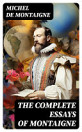
Literary and Philosophical Essays: Restored Classics to Go Edition

· Otbebookpublishing
Ebook
611
Pages
Eligible

About this ebook

This collection brings together philosophical and literary essays that revolve around Montaigne and other major thinkers such as Bacon, Renan, Lessing, Schiller, Kant, and Mazzini. At its heart is Montaigne, the pioneering essayist whose candid, self-revealing method turns reflection into a portrait of the mind itself. His voice is intimate, humane, and skeptical of worldly triumphs, shaped by a life of study, public service, and retirement from ambition. Across these meditations, death becomes the central test of wisdom. Montaigne argues that no one can be called happy until the end is known, since fortune can destroy greatness in an instant and death strips away every mask. Through historical examples, sudden accidents, and humiliating endings, he shows that rank, strength, and caution offer no real protection. Philosophy, then, is a preparation for dying well: to live with courage, humility, detachment, and constant readiness. The volume also reflects on religion and revelation, presenting sacred teaching as a gradual education of humanity, from allegory and moral training to Christ's fuller doctrine of immortality and inward purity. Together, these essays form a searching inquiry into mortality, virtue, and the soul's deepest freedom. This edition has been fully restored with modern typesetting, custom cover design.
This collection brings together philosophical and literary essays that revolve around Montaigne and other major thinkers such as Bacon, Renan, Lessing, Schiller, Kant, and Mazzini. At its heart is Montaigne, the pioneering essayist whose candid, self-revealing method turns reflection into a portr...

About the author

Michel de Montaigne (1533–1592) was a French Renaissance nobleman, magistrate, and thinker whose life was shaped by public duty, private reflection, and a deep curiosity about human nature. Born into a prosperous family in southwestern France, he received an unusually humanist education before serving as a counselor and later as mayor of Bordeaux, experiences that gave him firsthand knowledge of politics, conflict, and the fragility of civil order. Retreating to his family estate, he turned inward and began the remarkable body of writing that made him one of the founders of the essay as a literary form. His most important achievement lies in his unsparing examination of himself and the world around him: he wrote about friendship, grief, fear, education, custom, ambition, death, and the limits of knowledge with a candor and flexibility that still feel strikingly modern. Rather than offering rigid doctrine, he embraced uncertainty, self-questioning, and the complexity of lived experience, creating a style that is intimate, reflective, and deeply humane. His work remains relevant today because it speaks to readers living amid political division, information overload, and competing truths, reminding us that wisdom often begins with humility and attention to the ordinary textures of life. Montaigne's legacy endures in the essay form, in modern skepticism, and in the idea that literature can be both personal and universal at once. Readers who enjoy thoughtful prose, philosophical reflection, and timeless questions about what it means to live well will find him especially rewarding.
Michel de Montaigne (1533–1592) was a French Renaissance nobleman, magistrate, and thinker whose life was shaped by public duty, private reflection, and a deep curiosity about human nature. Born into a prosperous family in southwestern France, he received an unusually humanist education before se...

Rate this ebook

Tell us what you think.

Reading information

Smartphones and tablets
Install the Google Play Books app for Android and iPad/iPhone. It syncs automatically with your account and allows you to read online or offline wherever you are.
Laptops and computers
You can listen to audiobooks purchased on Google Play using your computer's web browser.
eReaders and other devices
To read on e-ink devices like Kobo eReaders, you'll need to download a file and transfer it to your device. Follow the detailed Help Center instructions to transfer the files to supported eReaders.