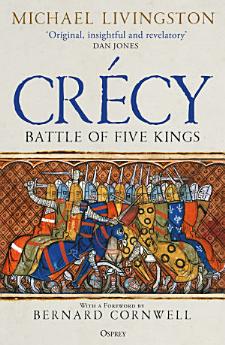
Crécy: Battle of Five Kings
Jun 2022 · Bloomsbury Publishing
star
2 reviews
Ebook
304
Pages
About this ebook
'Like Crécy itself, this book is a triumph and the tale it tells gives an old story new life.' BERNARD CORNWELL, bestselling author of The Last Kingdom series
The battle of Crécy in 1346 is one of the most famous and widely studied military engagements in history. The repercussions of this battle were felt for hundreds of years, and the exploits of those fighting reached the status of legend. Yet cutting-edge research has shown that nearly everything that has been written about this dramatic event may be wrong.
In this new study, Michael Livingston reveals how modern scholars have used archived manuscripts, satellite technologies and traditional fieldwork to help unlock what was arguably the battle's greatest secret: the location of the now quiet fields where so many thousands died.
Crécy: Battle of Five Kings is a story of past and present. It is a new history of one of the most important battles of the Middle Ages: a compelling narrative account that nonetheless adheres to the highest scholarly standards in its detail. It is also an account that incorporates the most cutting-edge revelations and the personal story of how those discoveries were made.
'Like Crécy itself, this book is a triumph and the tale it tells gives an old story new life.' BERNARD CORNWELL, bestselling author of The Last Kingdom series
The battle of Crécy in 1346 is one of the most famous and widely studied military engagements in history. The repercussions of this battl...
Discover more
Ratings and reviews
2 reviews

Jonathan Dean
- Flag inappropriate
September 23, 2022
There's insufficient characters for a full review, but Livingston simply hasn't addressed the criticism of Andrew Ayton and Michael Prestwich, especially regarding his translations. "Apud" is "at", not "near" "Devaunt"/"devant" does mean "before", but in the sense of "in front of" or "ahead of". "Versus" can mean "towards", but also "facing"/"adjoining" and "in the direction". "Devers" can mean "towards", but also "near", "at", "around", "on the side of" and "beside". Additionally, as a verb "devers" is often used to indicate that a person or thing is "from" a place. "Iuxta" does mean "near", but with connotations of being "hard by", "right next to" and "close to", which suggest a closer distance than the several miles from the proposed new location. "Usque" doesn't mean "towards" but rather "right up to", "all the way to", "as far as". "Emprés" does mean "near", but also "beside" and has a connotation of being "about" or "around" rather than a generic "near".
About the author
Dr Michael Livingston teaches the military and cultural history of the Middle Ages at The Citadel, the Military College of South Carolina. He co-authored the textbook reader Medieval Warfare, and future works include books on the battles of Hastings and Shrewsbury. These add to previous books The Battle of Crécy: A Casebook, winner of the 2017 Distinguished Book Award from the Society for Military History, and Never Greater Slaughter: Brunanburh and the Birth of England (Osprey, 2021).
Dr Michael Livingston teaches the military and cultural history of the Middle Ages at The Citadel, the Military College of South Carolina. He co-authored the textbook reader Medieval Warfare, and future works include books on the battles of Hastings and Shrewsbury. These add to previous books The...
Rate this ebook
Tell us what you think.
Reading information
Smartphones and tablets
Install the Google Play Books app for Android and iPad/iPhone. It syncs automatically with your account and allows you to read online or offline wherever you are.
Laptops and computers
You can listen to audiobooks purchased on Google Play using your computer's web browser.
eReaders and other devices
To read on e-ink devices like Kobo eReaders, you'll need to download a file and transfer it to your device. Follow the detailed Help Center instructions to transfer the files to supported eReaders.