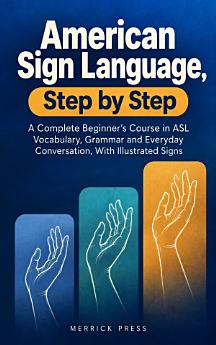
American Sign Language, Step by Step: A Complete Beginner's Course in ASL Vocabulary, Grammar and Everyday Conversation, With Illustrated Signs
About this ebook
Starting from the manual alphabet and numbers, this book walks you through the building blocks of ASL grammar, including topic comment order, non manual markers, and spatial pronouns, before moving into the vocabulary you will actually use: greetings, family, emotions, colors, food, time, directional verbs, question words, classifiers, and everyday courtesy phrases. Five full sample dialogues show how the pieces fit together in real conversation.
Every major sign in the book is shown in an original schematic illustration, so you can see the handshape, the contact point, and the movement at a glance, not just read a description of it.
This book treats ASL as its own full language from the first page, not a signed version of English. Along the way you will learn why ASL grammar works the way it does, why the signer's face carries real grammatical information, and why practicing with real Deaf signers matters more than any book alone, including this one.
Inside you will find: the manual alphabet and numbers one through ten with reference charts, core ASL grammar including topic comment order, non manual markers and spatial pronouns, sixteen vocabulary chapters covering family, emotions, food, time and directions, directional verbs, classifiers and wh question words explained clearly, five sample dialogues showing real conversational ASL, twenty four original illustrations showing exact handshapes and movement, and notes on Deaf culture and community throughout.
Whether you are a parent, a student, a coworker of a Deaf colleague, or simply curious about a new language, this course gives you a genuine foundation to build on.
About the author
Merrick Press publishes clear, practical instructional guides for beginners across a range of everyday subjects. Each title is built around the idea that a new skill is easiest to learn when it is broken into small, well-sequenced steps, explained in plain language, and shown rather than only described. Merrick Press titles are developed with attention to accuracy, to the lived context of the communities a subject touches, and to giving a genuine beginner a real foundation to build on, rather than a quick overview that leaves the real work undone.