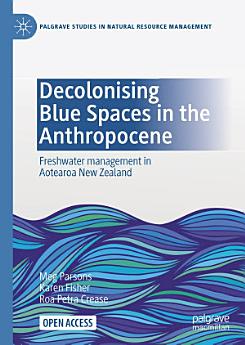
Decolonising Blue Spaces in the Anthropocene: Freshwater management in Aotearoa New Zealand
Meg Parsons · Karen Fisher · Roa Petra Crease
Feb 2021 · Springer Nature
Ebook
494
Pages
About this ebook
This open access book crosses disciplinary boundaries to connect theories of environmental justice with Indigenous people’s experiences of freshwater management and governance. It traces the history of one freshwater crisis – the degradation of Aotearoa New Zealand’s Waipā River– to the settler-colonial acts of ecological dispossession resulting in intergenerational injustices for Indigenous Māori iwi (tribes). The authors draw on a rich empirical base to document the negative consequences of imposing Western knowledge, worldviews, laws, governance and management approaches onto Māori and their ancestral landscapes and waterscapes. Importantly, this book demonstrates how degraded freshwater systems can and are being addressed by Māori seeking to reassert their knowledge, authority, and practices of kaitiakitanga (environmental guardianship). Co-governance and co-management agreements between iwi and the New Zealand Government, over the Waipā River, highlight how Māori are envisioning and enacting more sustainable freshwater management and governance, thus seeking to achieve Indigenous environmental justice (IEJ).
The book provides an accessible way for readers coming from a diversity of different backgrounds, be they academics, students, practitioners or decision-makers, to develop an understanding of IEJ and its applicability to freshwater management and governance in the context of changing socio-economic, political, and environmental conditions that characterise the Anthropocene.
The book provides an accessible way for readers coming from a diversity of different backgrounds, be they academics, students, practitioners or decision-makers, to develop an understanding of IEJ and its applicability to freshwater management and governance in the context of changing socio-economic, political, and environmental conditions that characterise the Anthropocene.
This open access book crosses disciplinary boundaries to connect theories of environmental justice with Indigenous people’s experiences of freshwater management and governance. It traces the history of one freshwater crisis – the degradation of Aotearoa New Zealand’s Waipā River– to the settler-c...
Discover more
About the author
Meg Parsons is senior lecturer at the University of Auckland, New Zealand who specialises in historical geography and Indigenous peoples’ experiences of environmental changes. Of Indigenous and non-Indigenous heritage (Ngāpuhi, Pākehā, Lebanese), Parsons is a contributing author to IPCC’s Sixth Assessment of Working Group II report and the author of 34 publications.
Karen Fisher (Ngāti Maniapoto, Waikato-Tainui, Pākehā) is an associate professor in the School Environment, University of Auckland, New Zealand. Aotearoa New Zealand. She is a human geographer with research interests in environmental governance and the politics of resource use in freshwater and marine environments.
Roa Petra Crease (Ngāti Maniapoto, Filipino, Pākehā) is an early career researcher who employs theorising from feminist political ecology to examine climate change adaptation for Indigenous and marginalised peoples. Recent publications explore theintersections of gender justice and climate justice in the Philippines, and mātuaranga Māori (knowledge) of flooding.
Meg Parsons is senior lecturer at the University of Auckland, New Zealand who specialises in historical geography and Indigenous peoples’ experiences of environmental changes. Of Indigenous and non-Indigenous heritage (Ngāpuhi, Pākehā, Lebanese), Parsons is a contributing author to IPCC’s Sixth A...
Rate this ebook
Tell us what you think.
Reading information
Smartphones and tablets
Install the Google Play Books app for Android and iPad/iPhone. It syncs automatically with your account and allows you to read online or offline wherever you are.
Laptops and computers
You can listen to audiobooks purchased on Google Play using your computer's web browser.
eReaders and other devices
To read on e-ink devices like Kobo eReaders, you'll need to download a file and transfer it to your device. Follow the detailed Help Center instructions to transfer the files to supported eReaders.


