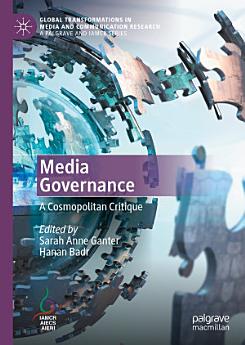
Media Governance: A Cosmopolitan Critique

·
· Springer Nature
E-book
318
Pages

À propos de cet e-book

The book offers a critical map to navigate the field of media governance. A thread of cosmopolitan critique connects the fourteen chapters to enhance media governance literature beyond the West and regional foci. The first part addresses the epistemological and ontological flaws in the use and adaptation of media governance. The second part opens pathways for critique and provides a thorough understanding of the ambivalences that scholars encounter when addressing media governance as a field of study. The third part highlights shortcomings like geographical narrowness and tensions in the use of media governance concepts. The scholarly contributions show that media governance as a field of study is far from being established: its conceptualizations are in flux and need scholarly self-reflection, and ongoing discussions need to leave behind universalist conceptualizations and methods of analysis. The chapters reflect on hegemony, power, sovereignty, and identity as conceptual center points in media governance research. The book uniquely breaks with self-referential Western academia and is part of ongoing collaborative scholarly efforts towards epistemic transformation through dialogue.
The book offers a critical map to navigate the field of media governance. A thread of cosmopolitan critique connects the fourteen chapters to enhance media governance literature beyond the West and regional foci. The first part addresses the epistemological and ontological flaws in the use and ad...

En voir d'autres

À propos de l'auteur

Sarah Anne Ganter is Assistant Professor of Communication and Cultural Policy in the School of Communication at Simon Fraser University in Vancouver. Her work is influenced by a cosmopolitan approach to academic work, integrating scholarly work from different cultural, linguistic and geographical academic settings She has published widely on media governance, digital policy and regulation, and journalism, and analyzes media and digital policy transformations from a theoretical perspective that focuses on the dynamics and interactions shaping institutional fields. Her work is published in scholarly journals, international book projects, including the co-authored book “The Power of Platforms: Shaping Media and Society.”

Hanan Badr is Professor for Public Spheres and Inequalities at the Department of Communication, University of Salzburg, Austria. Her work focuses comparing media systems, diversifying communication research, globalization and digitization transform journalism and She held positions at Freie Universität Berlin, Cairo University, Gulf University for Sciences and Technology and Orient-Institut Beirut. Her work was published in Digital Journalism, International Communication Gazette, Media & Communication and Media, War & Conflict. Hanan won awards including the Kluge Fellowship at the Library of Congress and the DAAD Scholarship Award. She was elected as a Vice-Chair for the Activism, Communication and Social Change at the International Communication Association and serves as Regional Liasion Coordinator for AEJMC International Communication Division ICD.



Sarah Anne Ganter is Assistant Professor of Communication and Cultural Policy in the School of Communication at Simon Fraser University in Vancouver. Her work is influenced by a cosmopolitan approach to academic work, integrating scholarly work from different cultural, linguistic and geographical...

Donner une note à cet e-book

Dites-nous ce que vous en pensez.

Informations sur la lecture

Smartphones et tablettes
Installez l'application Google Play Livres pour Android et iPad ou iPhone. Elle se synchronise automatiquement avec votre compte et vous permet de lire des livres en ligne ou hors connexion, où que vous soyez.
Ordinateurs portables et de bureau
Vous pouvez écouter les livres audio achetés sur Google Play à l'aide du navigateur Web de votre ordinateur.
Liseuses et autres appareils
Pour lire sur des appareils e-Ink, comme les liseuses Kobo, vous devez télécharger un fichier et le transférer sur l'appareil en question. Suivez les instructions détaillées du Centre d'aide pour transférer les fichiers sur les liseuses compatibles.