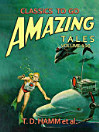
Amazing Tales Volume 187: Restored Classics to Go Edition
About this ebook
Discover more
About the author
Maurice Baudin, born in 1923 in the picturesque town of Arles, France, emerged as a luminary in the realm of speculative fiction. His early life was marked by the turbulence of World War II, during which he served as a cryptographer for the French Resistance. This experience profoundly influenced his later works, imbuing them with themes of secrecy, rebellion, and the human spirit's resilience.Baudin's literary career took off in the 1950s, a period when science fiction was gaining traction as a serious literary genre. He quickly distinguished himself with his imaginative storytelling and philosophical depth. His works often explored the ethical implications of technological advancements and the potential dystopian futures they could create. This foresight earned him a reputation as a visionary, and his ideas resonated with a generation grappling with the rapid pace of post-war technological change.Controversy was never far from Baudin. His outspoken criticism of nuclear proliferation and his advocacy for civil liberties made him a polarizing figure. In the 1960s, he was blacklisted by several publishing houses for his radical views, but this only fueled his determination. He self-published several works that are now considered classics of the genre.Baudin's influence on contemporary writers is undeniable. Authors like Philip K. Dick and Ursula K. Le Guin have cited him as a major inspiration. His revolutionary ideas about artificial intelligence and virtual reality predated the digital age, making him a prophet of the modern world.Maurice Baudin passed away in 1987, but his legacy endures. His works continue to challenge and inspire, reminding us of the power of speculative fiction to question the status quo and envision new possibilities for humanity.