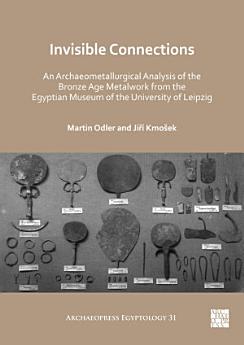
Invisible Connections: An Archaeometallurgical Analysis of the Bronze Age Metalwork from the Egyptian Museum of the University of Leipzig
Dec 2020 · Archaeopress Egyptology Book 31 · Archaeopress Publishing Ltd
Ebook
200
Pages
family_home
Eligible
info
About this ebook
The Egyptian Museum of the University of Leipzig has the largest university collection of ancient Egyptian artefacts in Germany. It includes important objects from the excavations of the most prolific excavator among the museum’s curators, Georg Steindorff, at the sites of Abusir, Aniba, and Giza, complemented by objects from Abydos, Thebes, and Kerma. The catalogue represents the results of an interdisciplinary project by Egyptologist and archaeologist Martin Odler, archaeometalurgist Jiří Kmošek and other participating researchers. A selection of 86 artefacts was analysed using a range of archaeometallurgical methods (X-ray fluorescence; metallography; neutron activation analysis; lead isotope analysis), providing a diachronic sample of Bronze Age Egyptian copper alloy metalwork from Dynasty 1 to Dynasty 19.
Besides currently popular focus on the ore provenance, the selection of the applied methods aimed also at the description of practical physical properties of the objects. The question of differences between full-size functional artefacts and models is addressed, as is the problem of 'imports' and their ethnic interpretation. The analyses brought many unexpected results to light, the most surprising being a bowl (ÄMUL 2162) made of arsenical copper high in nickel, which has parallels in Chalcolithic and Early Bronze Age Anatolia, and was featured in an article in the Journal of Archaeological Science in 2018. The corpus presented here involves the largest analysed metalwork assemblage from the Nubian C-Group and the Egyptian New Kingdom, and it addresses the issue of the use of local Nubian ore sources versus the sources of copper from Cyprus and elsewhere.
Besides currently popular focus on the ore provenance, the selection of the applied methods aimed also at the description of practical physical properties of the objects. The question of differences between full-size functional artefacts and models is addressed, as is the problem of 'imports' and their ethnic interpretation. The analyses brought many unexpected results to light, the most surprising being a bowl (ÄMUL 2162) made of arsenical copper high in nickel, which has parallels in Chalcolithic and Early Bronze Age Anatolia, and was featured in an article in the Journal of Archaeological Science in 2018. The corpus presented here involves the largest analysed metalwork assemblage from the Nubian C-Group and the Egyptian New Kingdom, and it addresses the issue of the use of local Nubian ore sources versus the sources of copper from Cyprus and elsewhere.
The Egyptian Museum of the University of Leipzig has the largest university collection of ancient Egyptian artefacts in Germany. It includes important objects from the excavations of the most prolific excavator among the museum’s curators, Georg Steindorff, at the sites of Abusir, Aniba, and Giza...
Discover more
About the author
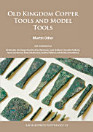
Martin Odler defended his PhD thesis in 2020. In 2016, he published the monograph Old Kingdom Copper Tools and Model Tools, the first of its kind in Egyptology, with Archaeopress. In Abusir (Egypt), he co-led the excavation of a new type of Egyptian tomb (AS 103) and of the latest known tomb of a transitional type from early Dynasty 4 (AS 104). ;
Jiří Kmošek is an archaeometallurgist, a PhD candidate at the Institute for Natural Sciences and Technology in the Arts, Academy of Fine Arts Vienna. He has analysed not only ancient Egyptian material but also Bronze Age metalwork from the Czech Republic.
Jiří Kmošek is an archaeometallurgist, a PhD candidate at the Institute for Natural Sciences and Technology in the Arts, Academy of Fine Arts Vienna. He has analysed not only ancient Egyptian material but also Bronze Age metalwork from the Czech Republic.
Martin Odler defended his PhD thesis in 2020. In 2016, he published the monograph Old Kingdom Copper Tools and Model Tools, the first of its kind in Egyptology, with Archaeopress. In Abusir (Egypt), he co-led the excavation of a new type of Egyptian tomb (AS 103) and of the latest known tomb of a...
Rate this ebook
Tell us what you think.
Reading information
Smartphones and tablets
Install the Google Play Books app for Android and iPad/iPhone. It syncs automatically with your account and allows you to read online or offline wherever you are.
Laptops and computers
You can listen to audiobooks purchased on Google Play using your computer's web browser.
eReaders and other devices
To read on e-ink devices like Kobo eReaders, you'll need to download a file and transfer it to your device. Follow the detailed Help Center instructions to transfer the files to supported eReaders.