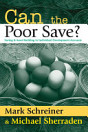
Can the Poor Save?: Saving and Asset Building in Individual Development Accounts
Dec 2011 · Transaction Publishers
Ebook
385
Pages
family_home
Eligible
info
About this ebook
Many policymakers argue that the best poverty policy not only provides cash to the poor for subsistence but also incentives and structures that encourage long-term social and economic improvement. As part of this, they make the case for Individual Development Accounts (IDAs), a new policy proposal designed to help the poor save and to build assets. This book explores IDAs to determine their effectiveness. IDAs are matched savings accounts targeted on low-income, low-wealth individuals. Savings in IDAs are used for home ownership, post-secondary education, small business development, and other purposes. Do IDAs work? If they do, for whom? And does how an IDA is designed determine savings outcomes? This volume is the first analysis of matched savings by the poor to use data from monthly bank statements. It comes at a critical time, as debate rages over the merits of individual social security accounts. IDAs also respond to policy that is becoming more asset based and less inclusive of the poor. The authors argue for the efficacy of IDAs to counter this tendency. They find that while savings outcomes vary among participants, no characteristics (such as low income or public assistance) preclude saving. They examine effects of IDA design (the match rate, savings targets, and the use of automatic transfer) on savings results and analyze factors that influence varying rates of saving and spending over time. They conclude that financial education and other support services, though costly, improve savings performance. To address the issue of cost they suggest a two-tier system of IDA design, one with broad access and simple services and the other with targeted access and intensive services. Can the Poor Save? offers a wealth of lessons to those interested in saving and asset accumulation among the poor. It not only breaks new ground in the scientific study of savings behavior, but also offers concrete, evidence-based recommendations to improve policies designed to encourage the poor to save and how to make such policies more inclusive.
Many policymakers argue that the best poverty policy not only provides cash to the poor for subsistence but also incentives and structures that encourage long-term social and economic improvement. As part of this, they make the case for Individual Development Accounts (IDAs), a new policy proposa...
About the author
Mark Schreiner is a senior scholar in the Center for Social Development at Washington University in St. Louis and also director of Microfinance Risk Management.
Michael Sherraden is the Benjamin E. Youngdahl Professor of Social Development and director of the Center for Social Development, George Warren Brown School of Social Work at Washington University in St. Louis.
Mark Schreiner is a senior scholar in the Center for Social Development at Washington University in St. Louis and also director of Microfinance Risk Management. Michael Sherraden is the Benjamin E. Youngdahl Professor of Social Development and director of the Center for Social Development, George...
Rate this ebook
Tell us what you think.
Reading information
Smartphones and tablets
Install the Google Play Books app for Android and iPad/iPhone. It syncs automatically with your account and allows you to read online or offline wherever you are.
Laptops and computers
You can listen to audiobooks purchased on Google Play using your computer's web browser.
eReaders and other devices
To read on e-ink devices like Kobo eReaders, you'll need to download a file and transfer it to your device. Follow the detailed Help Center instructions to transfer the files to supported eReaders.