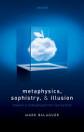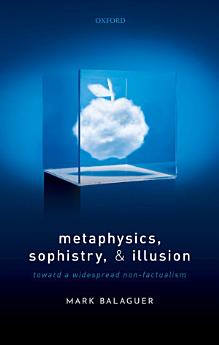
Metaphysics, Sophistry, and Illusion: Toward a Widespread Non-Factualism
Jan 2021 · Oxford University Press
Ebook
336
Pages
family_home
Eligible
info
About this ebook
Metaphysics, Sophistry, and Illusion does two things. First, it introduces a novel kind of non-factualist view, and argues that we should endorse views of this kind in connection with a wide class of metaphysical questions, most notably, the abstract-object question and the composite-object question. (More specifically, Mark Balaguer argues that there's no fact of the matter whether there are any such things as abstract objects or composite objects—or material objects of any other kind.) Second, Metaphysics, Sophistry, and Illusion explains how these non-factualist views fit into a general anti-metaphysical view called neo-positivism, and explains how we could argue that neo-positivism is true. Neo-positivism is the view that every metaphysical question decomposes into some subquestions—call them Q1, Q2, Q3, etc.—such that, for each of these subquestions, one of the following three anti-metaphysical views is true of it: non-factualism, or scientism, or metaphysically innocent modal-truth-ism. These three views can be defined (very roughly) as follows: non-factualism about a question Q is the view that there's no fact of the matter about the answer to Q. Scientism about Q is the view that Q is an ordinary empirical-scientific question about some contingent aspect of physical reality, and Q can't be settled with an a priori philosophical argument. And metaphysically innocent modal-truth-ism about Q is the view that Q asks about the truth value of a modal sentence that's metaphysically innocent in the sense that it doesn't say anything about reality and, if it's true, isn't made true by reality
Metaphysics, Sophistry, and Illusion does two things. First, it introduces a novel kind of non-factualist view, and argues that we should endorse views of this kind in connection with a wide class of metaphysical questions, most notably, the abstract-object question and the composite-object quest...
About the author
Mark Balaguer received a BA in Philosophy and Mathematics from the University of Colorado at Boulder, and a PhD in Philosophy from the City University of New York Graduate Center. He is the author of Platonism and Anti-Platonism in Mathematics (Oxford University Press, 1998), Free Will as an Open Scientific Problem (MIT Press, 2010), and Free Will (MIT Press, 2014), as well as numerous journal articles on a wide range of philosophical topics.
Mark Balaguer received a BA in Philosophy and Mathematics from the University of Colorado at Boulder, and a PhD in Philosophy from the City University of New York Graduate Center. He is the author of Platonism and Anti-Platonism in Mathematics (Oxford University Press, 1998), Free Will as an Open...
Rate this ebook
Tell us what you think.
Reading information
Smartphones and tablets
Install the Google Play Books app for Android and iPad/iPhone. It syncs automatically with your account and allows you to read online or offline wherever you are.
Laptops and computers
You can listen to audiobooks purchased on Google Play using your computer's web browser.
eReaders and other devices
To read on e-ink devices like Kobo eReaders, you'll need to download a file and transfer it to your device. Follow the detailed Help Center instructions to transfer the files to supported eReaders.