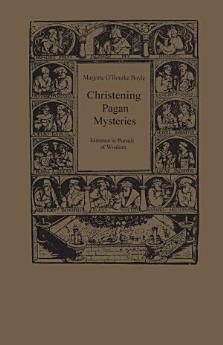
Christening Pagan Mysteries: Erasmus in Pursuit of Wisdom

· University of Toronto Press
Ebook
190
Pages
Tools

About this ebook

This is the first book devoted to investigating the scholarly commonplace that Erasmus’ revival of classical learning defines his evangelical humanism. It acknowledges that it was a feat for him to challenge the obscurantism of late medieval schooling by restoring classical studies. It recognizes that his editions of Greek and Latin authors alone fix his place in the history of scholarship. But the plainest questions about this achievement may still be asked, and the most popular texts freshly interpreted. Was his work only the expression in the ‘idiom of the Renaissance’ or a perennial Christian humanism? Or did he advance on it theoretically as well as practically? Did Erasmus contribute conceptually to the interrogation of pagan wisdom with the Christian economy? Christening Pagan Mysteries proposes that he did.

Although doctrinal issues involved, this inquiry is not systematically theological. Erasmus wrote no treatise on the subject that might be so explored. A rhetorical approach, complementary to his own method, discloses his evangelical humanism through the analysis of three significant texts. The seminal dialogue Antibarbari provides the conceptual key in one of the most important humanist declarations in the history of Christian thought to the Renaissance. The Christocentric conviction it voices is then discerned through new interpretations of two other texts which christen pagan mysteries in original and important ways: the Moria and the final colloquy, ‘Epicureus,’ in which a pagan goddess and a pagan philosopher are gathered to Christ.

This is the first book devoted to investigating the scholarly commonplace that Erasmus’ revival of classical learning defines his evangelical humanism. It acknowledges that it was a feat for him to challenge the obscurantism of late medieval schooling by restoring classical studies. It recognizes...

Discover more

About the author

Marjorie O'Rourke Boyle is a faculty member of the Centre for Medieval Studies, University of Toronto. She is the author of Erasmus on Language and Method in Theology in this series, and an editor of volumes for the Collected Works of Erasmus.

Marjorie O'Rourke Boyle is a faculty member of the Centre for Medieval Studies, University of Toronto. She is the author of Erasmus on Language and Method in Theology in this series, and an editor of volumes for the Collected Works of Erasmus.
Rate this ebook

Tell us what you think.

Reading information

Smartphones and tablets
Install the Google Play Books app for Android and iPad/iPhone. It syncs automatically with your account and allows you to read online or offline wherever you are.
Laptops and computers
You can listen to audiobooks purchased on Google Play using your computer's web browser.
eReaders and other devices
To read on e-ink devices like Kobo eReaders, you'll need to download a file and transfer it to your device. Follow the detailed Help Center instructions to transfer the files to supported eReaders.