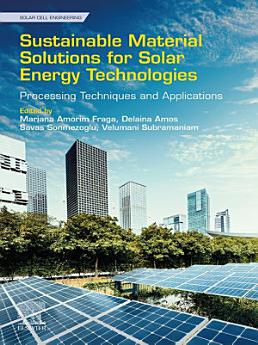
Sustainable Material Solutions for Solar Energy Technologies: Processing Techniques and Applications

· · ·
· Elsevier
Ebook
668
Pages
Eligible

About this ebook

Sustainable Material Solutions for Solar Energy Technologies: Processing Techniques and Applications provides an overview of challenges that must be addressed to efficiently utilize solar energy. The book explores novel materials and device architectures that have been developed to optimize energy conversion efficiencies and minimize environmental impacts. Advances in technologies for harnessing solar energy are extensively discussed, with topics including materials processing, device fabrication, sustainability of materials and manufacturing, and current state-of-the-art. Leading international experts discuss the applications, challenges, and future prospects of research in this increasingly vital field, providing a valuable resource for students and researchers working in this field. - Explores the fundamentals of sustainable materials for solar energy applications, with in-depth discussions of the most promising material solutions for solar energy technologies: photocatalysis, photovoltaic, hydrogen production, harvesting and storage - Discusses the environmental challenges to be overcome and importance of efficient materials utilization for clean energy - Looks at design materials processing and optimization of device fabrication via metrics such as power-to-weight ratio, effectiveness at EOL compared to BOL, and life-cycle analysis
Sustainable Material Solutions for Solar Energy Technologies: Processing Techniques and Applications provides an overview of challenges that must be addressed to efficiently utilize solar energy. The book explores novel materials and device architectures that have been developed to optimize energ...

Discover more

About the author

Prof. Mariana Amorim Fraga is a Professor at the Electrical Engineering Program, Mackenzie Presbyterian University, Brazil. Leader of the Photovoltaic Sensors and Devices research group. She was a Visiting Professor at the Biomedical Engineering Program, Federal University of São Paulo (UNIFESP, Brazil). She obtained her MSc in Electrical Engineering from the University of São Paulo (USP, Brazil) and her PhD in Aeronautics and Mechanical Engineering from the Technological Institute of Aeronautics (ITA, Brazil). Her research interests are in the materials science and engineering areas, mainly on the synthesis and characterization of nanomaterials for the development of sensors, electronic devices and energy technologies.

Delaina Amos received a BS in Chemical Engineering from the University of Virginia in 1989. She later obtained a MS and PhD in Chemical Engineering from the University of California Berkley in 1992 and 1996 where she was both a GEM MS fellow and among the first class of GEM Engineering PhD Fellows. After completing a one-year industrial post-doctoral assignment at Eastman Kodak, Dr. Amos joined the research staff at Eastman Kodak in 1997. Dr. Amos held a variety of roles at Kodak including research scientist, R&D team leader, technical liaison, and intellectual property co-leader. While at Kodak, work that she was involved in went into creating the new platform of pigment-based inks for the Kodak consumer printer lines. Dr. Amos joined the faculty of the Department of Chemical Engineering at the University of Louisville in June 2010 as an Associate Professor.

Savas Sonmezoglu is a Professor in the Department of Metallurgical and Materials Engineering at Karamanoglu Mehmetbey University; a faculty member since 2012. His research focuses on the synthesis of inorganic nano-materials for solar cells applications such as perovskite and dye-sensitized solar cells. He has authored or co-authored more than 70 peer-reviewed scientific publications and book chapters. He also serves as editorial board member and peer reviewer for various international journals.

Velumani Subramaniam is an Associate Professor in the Department of Mechanical Engineering at Texas A&M University, United States. He is presently working on novel micro- and nano-structured materials for harvesting renewable energy and for biomedical applications.
Prof. Mariana Amorim Fraga is a Professor at the Electrical Engineering Program, Mackenzie Presbyterian University, Brazil. Leader of the Photovoltaic Sensors and Devices research group. She was a Visiting Professor at the Biomedical Engineering Program, Federal University of São Paulo (UNIFESP, ...

Rate this ebook

Tell us what you think.

Reading information

Smartphones and tablets
Install the Google Play Books app for Android and iPad/iPhone. It syncs automatically with your account and allows you to read online or offline wherever you are.
Laptops and computers
You can listen to audiobooks purchased on Google Play using your computer's web browser.
eReaders and other devices
To read on e-ink devices like Kobo eReaders, you'll need to download a file and transfer it to your device. Follow the detailed Help Center instructions to transfer the files to supported eReaders.