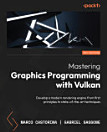
Mastering Graphics Programming With Vulkan: Develop a modern rendering engine featuring GPU-driven rendering, advanced lighting, and ray tracing, Edition 2

·
· Packt Publishing Ltd
Ebook
526
Pages
Tools

About this ebook

Level up your graphics programming with Vulkan by building a modern renderer with GPU-driven techniques, ray tracing, advanced lighting, and neural materials Free with your book: DRM-free PDF version + access to Packt's next-gen Reader* Key Features
  • Build a modern Vulkan renderer using a lightweight Vulkan accelerator framework, with bindless resources, frame graphs, and async GPU submission
  • Implement GPU-driven rendering with mesh shaders, GPU culling, and shadows
  • Advance from hardware ray tracing and ReSTIR GI to neural rendering with Slang
  • *Email sign-up and proof of purchase required
Book DescriptionBuilding a modern rendering engine can feel overwhelming when basic Vulkan tutorials only take you so far. This second edition bridges that gap, showing you how production-focused rendering systems manage resources, GPU work submission, geometry, and lighting, while incorporating techniques such as GPU-driven rendering, ray tracing, and ReSTIR GI. You’ll gain clarity and confidence working with the API thanks to a framework that strips away the boilerplate while preserving Vulkan’s concepts. As you progress, you’ll explore Vulkan features such as descriptor indexing, mesh shaders, and async compute for performance and flexibility. You’ll also use frame graphs to build a rendering architecture designed to scale and simplify resource management. From there, you’ll build GPU-driven rendering that leverages meshlets and GPU-based culling, then move into Vulkan ray tracing for shadows and reflections and implement ReSTIR GI. Finally, you’ll apply differentiable rendering with Slang to create neural materials. Written by two experienced graphics programmers, this book combines theory with implementation-focused guidance to help you gain practical skills. By the end, you’ll not only understand the Vulkan API at a deeper level but also have the knowledge to design and build your own modern renderer.What you will learn
  • Manage GPU resources with bindless descriptors and shader reflection
  • Build a frame graph and coordinate asynchronous GPU workloads
  • Implement GPU-driven rendering with meshlets and mesh shaders
  • Render many lights and GPU-driven shadows efficiently
  • Implement volumetric fog, temporal anti-aliasing (TAA), and temporal upscaling
  • Build Vulkan acceleration structures and ray-tracing pipelines
  • Implement ray-traced shadows, reflections, and ReSTIR GI
  • Create neural materials with Slang and differentiable rendering
Who this book is for

Ideal for graphics programmers and engine developers who are already familiar with Vulkan or modern graphics APIs and want to deepen their understanding of real-time rendering architecture and system design. You should already be comfortable with C++, graphics fundamentals such as vectors and matrices, and core Vulkan concepts including pipelines, descriptors, command buffers, and GPU resource management. Motivated hobbyists and early-career developers can also benefit, provided they are comfortable with these core Vulkan concepts and ready to engage with more advanced architectural topics.

Level up your graphics programming with Vulkan by building a modern renderer with GPU-driven techniques, ray tracing, advanced lighting, and neural materials Free with your book: DRM-free PDF version + access to Packt's next-gen Reader* Key Features Build a modern Vulkan renderer using a lightwei...

Discover more

About the author

Marco Castorina first got familiar with Vulkan while working as a driver developer at Samsung. Later, he developed a 2D and 3D renderer in Vulkan from scratch for a leading media-server company. He later joined a graphics driver performance team focusing on D3D12 and now works in GPU architecture modeling. In his spare time, he keeps up to date with the latest techniques in real-time graphics. He also likes cooking and making music.

Gabriel Sassone is a rendering and engine engineer. He first encountered Vulkan while developing the Vulkan layer for the proprietary Apex Engine and its Google Stadia port at Avalanche Studios. He previously worked at ReadyAtDawn, Codemasters, FrameStudios, The Multiplayer Group, and some other non-gaming tech companies. His spare time is filled with music and rendering, gaming, and outdoor activities.
Marco Castorina first got familiar with Vulkan while working as a driver developer at Samsung. Later, he developed a 2D and 3D renderer in Vulkan from scratch for a leading media-server company. He later joined a graphics driver performance team focusing on D3D12 and now works in GPU architecture...

Rate this ebook

Tell us what you think.

Reading information

Smartphones and tablets
Install the Google Play Books app for Android and iPad/iPhone. It syncs automatically with your account and allows you to read online or offline wherever you are.
Laptops and computers
You can listen to audiobooks purchased on Google Play using your computer's web browser.
eReaders and other devices
To read on e-ink devices like Kobo eReaders, you'll need to download a file and transfer it to your device. Follow the detailed Help Center instructions to transfer the files to supported eReaders.