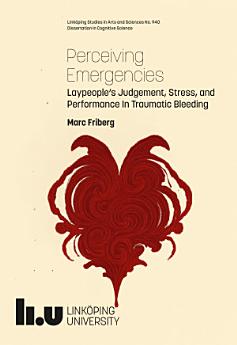
Perceiving Emergencies: Laypeople's Judgement, Stress, and Performance in Traumatic Bleeding
About this ebook
This thesis examines the cognitive, perceptual, and affective mechanisms underlying laypeople’s responses to life-threatening bleeding. Drawing on theories from cognitive science and human factors, most notably Brunswik’s lens model, naïve theories, and stress theory, the thesis conceptualizes medical emergencies as epistemic events shaped by uncertainty, probabilistic cues, and human sensemaking. From this perspective, recognizing and responding to hemorrhage is not solely a matter of technical skill acquisition, but of judgment under uncertainty, cue interpretation, and performance under stress.
The thesis consists of six papers. Five papers employing experimental, simulation-based methods, and one literature review. The included studies investigate how factors such as stress, exposure to blood, and visual characteristics of injuries influence laypeople’s ability to recognize hemorrhage, estimate blood loss, prioritize victims, and perform bleeding control interventions. Several studies directly assess performance rather than relying on surrogate outcomes such as confidence or intention, thereby addressing a key limitation in existing bleeding control research.
Across the included papers, the results demonstrate that laypeople’s hemorrhage control performance is systematically affected by cognitive and environmental constraints. Stress and salient trauma cues can impair both perceptual judgment and motor performance, while mismatches between perceived severity and actual injury severity highlight limitations in current training approaches. The findings suggest that conventional training models may insufficiently account for how laypeople attend to, interpret, and act upon probabilistic cues in emergency contexts.
By integrating empirical findings with theory-informed analysis, this thesis contributes to a more cognitively grounded understanding of layperson emergency response. The work advances knowledge on how hemorrhage control training can be better aligned with human perceptual and decision-making processes, and offers implications for the design of more effective, realistic, and transferable training for the general public. Ultimately, this research aims to support training practices that enhance early intervention capacity and societal resilience in medical emergencies.