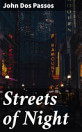
Manhattan Transfer
John Dos Passos
xan. de 1925 · Amereon Limited
Libro electrónico
404
Páxinas
Acerca deste libro electrónico
A modernist masterwork that has more in common with films than traditional novels, John Dos Passos' "Manhattan Transfer". A colourful, multi-faceted chronicle of New York in the early 1920s, "Manhattan Transfer" ranks with James Joyce's "Ulysses" as a powerful and often lyrical meditation on the modern city. Using experimental montage techniques borrowed from the cinema, vivid descriptions and bursts of overheard conversation, and the jumbled case histories of a picaresque cast of characters from dockside crapshooters to high-society flappers, Dos Passos constructs a brilliant impressionistic portrait of New York City as a great futuristic machine filled with motion, drama and human tragedy. John Dos Passos (1896-1970) was born in Chicago, the son of an eminent lawyer. After graduating from Harvard he served in the US Army Medical Corps during the First World War, and dabbled in journalism before embarking on life as a writer. In 1925 he published "Manhattan Transfer", his first experimental novel in what was to become his peculiar style - a mixture of fact and fiction. His began a series of panoramic epics of American life with the "USA" trilogy, using the same technique and tracing, through interwoven biographies, the story of America from the early twentieth century to the onset of the Great Depression in 1929. If you enjoyed "Manhattan Transfer", you might like Dos Passos' "U.S.A.", also available in "Penguin Modern Classics". "A modernist masterpiece, capturing ...the fragmented lives it sketches, in a dazzling kaleidoscope of New York City in the 1920s". (Christopher Hudson, "Evening Standard"). "Dos Passos has invented only one thing, an art of story-telling. But that is enough to create a universe". (Jean-Paul Sartre). "The best modern book about New York". (D.H. Lawrence).
A modernist masterwork that has more in common with films than traditional novels, John Dos Passos' "Manhattan Transfer". A colourful, multi-faceted chronicle of New York in the early 1920s, "Manhattan Transfer" ranks with James Joyce's "Ulysses" as a powerful and often lyrical meditation on the ...
Acerca do autor
John Dos Passos, 1896 - 1970 John Passos was born January 14,1896 to John Randolph Dos Passos and Lucy Addison Sprigg Madison. He attended Harvard University from 1912-1916. He was in the ambulance service units in France and Italy and in 1918, enlisted in the U.S. Army Medical Corps. From 1926-29, he directed New Playwrights' Theatre in New York City. In 1929, Passos married Katharine Smith and in 1947, they were in an automobile accident that killed his wife and left him blind in one eye. He married Elizabeth Holdridge in 1949 and a year later, Lucy Hamlin Dos Passos was born. Passos' many novels include "One Man's Initiation" (1917), "Three Soldiers" (1921), which has met with wide acclaim, "Streets of Night" (1923), "Facing the Chair" (1927), which defends the immigrants Sacco and Vanzetti, "Orient Express" (1927), "The Ground We Stand On" (1949), and "Prospects of a Golden Age" (1959). He received the Gold Medal for fiction from the National Institute of Arts and Letters in 1957, the Feltrinelli Prize for Fiction in 1967 and was elected to the American Academy of Arts and Letters in 1947. On September 28, 1970, Passos died of heart failure in Baltimore, Maryland.
John Dos Passos, 1896 - 1970 John Passos was born January 14,1896 to John Randolph Dos Passos and Lucy Addison Sprigg Madison. He attended Harvard University from 1912-1916. He was in the ambulance service units in France and Italy and in 1918, enlisted in the U.S. Army Medical Corps. From 1926-2...
Valora este libro electrónico
Dános a túa opinión.
Información de lectura
Smartphones e tabletas
Instala a aplicación Google Play Libros para Android e iPad/iPhone. Sincronízase automaticamente coa túa conta e permíteche ler contido en liña ou sen conexión desde calquera lugar.
Portátiles e ordenadores de escritorio
Podes escoitar os audiolibros comprados en Google Play a través do navegador web do ordenador.
Lectores de libros electrónicos e outros dispositivos
Para ler contido en dispositivos de tinta electrónica, como os lectores de libros electrónicos Kobo, é necesario descargar un ficheiro e transferilo ao dispositivo. Sigue as instrucións detalladas do Centro de axuda para transferir ficheiros a lectores electrónicos admitidos.