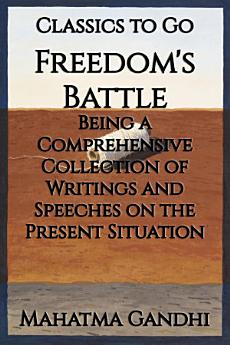
Freedom's Battle: Restored Classics to Go Edition

· Otbebookpublishing
Ebook
314
Pages
Eligible

About this ebook

This collection captures Mahatma Gandhi at a decisive moment in India's freedom struggle, when questions of reform, religion, and resistance converged into a single national crisis. Through speeches, essays, and letters, he confronts the Khilafat controversy, the Punjab atrocities, Swaraj, Hindu-Muslim unity, untouchability, Indians overseas, and the rising call for non-cooperation, arguing that Britain's reforms leave real power in imperial hands and do little to heal the wounds of colonial rule. At the heart of these writings is Gandhi's conviction that non-cooperation is a peaceful but forceful means of resistance, one that withdraws consent from unjust institutions and builds self-reliance, discipline, and civic responsibility. He defends support for Indian Muslims as a matter of dharma and justice, links Hindu-Muslim solidarity to India's moral strength, and frames Swaraj as a struggle that must be won through sacrifice and self-purification. He also denounces untouchability as a grave religious and social evil, while calling attention to the precarious condition of Indians in Fiji, East Africa, and South Africa. This edition has been fully restored with modern typesetting, custom cover design.
This collection captures Mahatma Gandhi at a decisive moment in India's freedom struggle, when questions of reform, religion, and resistance converged into a single national crisis. Through speeches, essays, and letters, he confronts the Khilafat controversy, the Punjab atrocities, Swaraj, Hindu-...

Discover more

About the author

Mohandas Karamchand Gandhi, known to the world as Mahatma Gandhi, was born in 1869 in Gujarat, India, and went on to become one of the most influential moral and political figures of the twentieth century. Trained in law, he developed his public voice through years of struggle in South Africa before returning to India to lead a mass movement against British colonial rule. What made Gandhi extraordinary was not only his leadership in the fight for independence, but the power of his writing and speeches, which combined clear argument, moral urgency, and a deep faith in truth, discipline, and nonviolence. His work consistently explored themes of justice, self-rule, civil disobedience, religious tolerance, simplicity, and the dignity of ordinary people, all of which remain strikingly relevant in a world still marked by conflict, inequality, and political division. Gandhi's legacy endures because he showed that ethical conviction can be a force for social change, and that resistance need not depend on hatred or violence. For modern readers, he remains a challenging and inspiring figure: a thinker who insisted that personal conduct and public action must be joined, and that freedom is meaningful only when it is grounded in responsibility and compassion. Readers interested in civil rights, political history, spiritual reflection, and the moral dimensions of activism will find his life and writings especially rewarding.
Mohandas Karamchand Gandhi, known to the world as Mahatma Gandhi, was born in 1869 in Gujarat, India, and went on to become one of the most influential moral and political figures of the twentieth century. Trained in law, he developed his public voice through years of struggle in South Africa bef...

Rate this ebook

Tell us what you think.

Reading information

Smartphones and tablets
Install the Google Play Books app for Android and iPad/iPhone. It syncs automatically with your account and allows you to read online or offline wherever you are.
Laptops and computers
You can listen to audiobooks purchased on Google Play using your computer's web browser.
eReaders and other devices
To read on e-ink devices like Kobo eReaders, you'll need to download a file and transfer it to your device. Follow the detailed Help Center instructions to transfer the files to supported eReaders.