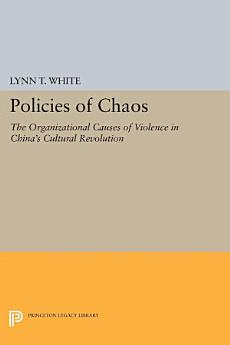
Policies of Chaos: The Organizational Causes of Violence in China's Cultural Revolution
Jul 2014 · Princeton University Press
Ebook
382
Pages
family_home
Eligible
info
About this ebook
The tumult of the Cultural Revolution after 1966 is often blamed on a few leaders in Beijing, or on long-term egalitarian ideals, or on communist or Chinese political cultures. Lynn White shows, however, that the chaos resulted mainly from reactions by masses of individuals and small groups to three specific policies of administrative manipulation: labeling groups, designating bosses, and legitimating violence in political campaigns. These habits of local organization were common after 1949 and gave the state success in short-term revolutionary aims, despite scarce resources and staff--but they also drove millions to attack each other later.
First, measures accumulated before 1966 to give people bad or good names (such as "rightist" or "worker"); these set a family's access to employment, education, residence, and rations--so they gave interests to potential conflict groups. Second, policies for bossism went far beyond Confucian patronage patterns, making work units tightly dependent on Party monitors--so rational individuals either pandered to local bosses or (when they could) deposed them. Third, the institutionalized violence of political campaigns both mobilized activists and scared others into compliance. These organizational measures were often effective in the short run before 1966 but accumulated social costs that China paid later. The book ends with comparisons to past cases of mass urban ostracism in other countries, and it suggests how such tragedies may be forecast or prevented in the future.
Originally published in 1989.
The Princeton Legacy Library uses the latest print-on-demand technology to again make available previously out-of-print books from the distinguished backlist of Princeton University Press. These editions preserve the original texts of these important books while presenting them in durable paperback and hardcover editions. The goal of the Princeton Legacy Library is to vastly increase access to the rich scholarly heritage found in the thousands of books published by Princeton University Press since its founding in 1905.
The tumult of the Cultural Revolution after 1966 is often blamed on a few leaders in Beijing, or on long-term egalitarian ideals, or on communist or Chinese political cultures. Lynn White shows, however, that the chaos resulted mainly from reactions by masses of individuals and small groups to th...
Discover more
Rate this ebook
Tell us what you think.
Reading information
Smartphones and tablets
Install the Google Play Books app for Android and iPad/iPhone. It syncs automatically with your account and allows you to read online or offline wherever you are.
Laptops and computers
You can listen to audiobooks purchased on Google Play using your computer's web browser.
eReaders and other devices
To read on e-ink devices like Kobo eReaders, you'll need to download a file and transfer it to your device. Follow the detailed Help Center instructions to transfer the files to supported eReaders.