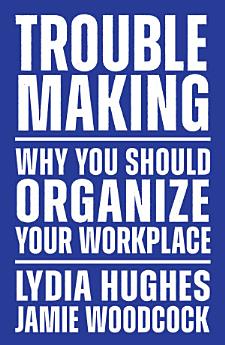
Troublemaking: Why You Should Organize Your Workplace
Apr 2023 · Verso Books
Ebook
192
Pages
Tools
info
family_home
Eligible
info
About this ebook
There are no unorganisable workers, only workers yet to be organised.
There has been an explosion of organising among workers many assumed to be unorganisable, from delivery drivers in London to tech workers in Silicon Valley.
The culmination of years of conversations on picket lines, in community centres, and in union offices, with workers in Britain, the US, India, Argentina, South Africa, Brazil, and across Europe, Troublemaking brings together lessons from around the world. Precarious workers waste collectors in Mumbai show that no worker is “unorganisable,” cleaner organising at LSE and St Mary’s hospital in London and Sans-papier workers in France indicate that demanding more at work can lead to big wins. Struggles like The Water Wars in Cochabamba, Bolivia show how we can use our power beyond the workplace.
From these movements, Lydia Hughes and Jamie Woodcock draw a number of lessons about why organising at work is the first step in building another world. They put forward three principles for organising. First, the need for action.
Struggles can change the world, but they also change people who go through them. Rather than using action as a last resort, we need action to build a movement. Second, the need to build the rank-and-file of unions. Power comes from organising at work, not in trusting others to do it on our behalf. Third, democracy matters in organising. This is not only about winning, but also developing the confidence to build another kind of world. This is not a “how to” guide, but a set of principles for the politics of organising.
There are no unorganisable workers, only workers yet to be organised.
There has been an explosion of organising among workers many assumed to be unorganisable, from delivery drivers in London to tech workers in Silicon Valley.
The culmination of years of conversations on picket lines, in commu...
Discover more
About the author
Lydia Hughes is a workplace organiser. She was the Head of Organising at the IWGB until 2021. She has been involved in organising with foster care workers, food delivery couriers, cycling instructors, cleaners, security guards, and game workers. She now supports socialist education initiatives and is active as a union member. She is an Editor at Notes from Below and Red Pepper.
Jamie Woodcock organised against casualised contracts as a UCU (University and College Union) member. He has been on strike with UCU many times since. Jamie became involved with the IWGB during the first strike of Deliveroo riders in London. He then became the secretary of the Universities of London branch. Following that, he was elected as the Branch Support Officer of the union, running the General Members branch and helping with new worker organising projects. He is the author of Working the Phones: Control and Resistance in Call Centres. He is an editor of Notes From Below and Historical Materialism.
Jamie Woodcock organised against casualised contracts as a UCU (University and College Union) member. He has been on strike with UCU many times since. Jamie became involved with the IWGB during the first strike of Deliveroo riders in London. He then became the secretary of the Universities of London branch. Following that, he was elected as the Branch Support Officer of the union, running the General Members branch and helping with new worker organising projects. He is the author of Working the Phones: Control and Resistance in Call Centres. He is an editor of Notes From Below and Historical Materialism.
Lydia Hughes is a workplace organiser. She was the Head of Organising at the IWGB until 2021. She has been involved in organising with foster care workers, food delivery couriers, cycling instructors, cleaners, security guards, and game workers. She now supports socialist education initiatives an...
Rate this ebook
Tell us what you think.
Reading information
Smartphones and tablets
Install the Google Play Books app for Android and iPad/iPhone. It syncs automatically with your account and allows you to read online or offline wherever you are.
Laptops and computers
You can listen to audiobooks purchased on Google Play using your computer's web browser.
eReaders and other devices
To read on e-ink devices like Kobo eReaders, you'll need to download a file and transfer it to your device. Follow the detailed Help Center instructions to transfer the files to supported eReaders.