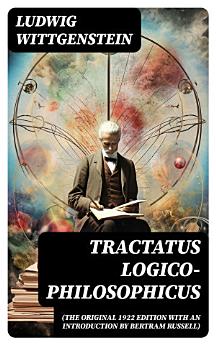
Tractatus Logico-Philosophicus (The original 1922 edition with an introduction by Bertram Russell)
Ludwig Wittgenstein
Dec 2023 · DigiCat
Ebook
91
Pages
family_home
Eligible
info
About this ebook
In the seminal work 'Tractatus Logico-Philosophicus,' first published in 1922, Ludwig Wittgenstein presents a groundbreaking exploration of the relationship between language, reality, and thought. The text unfolds through a series of propositions, meticulously structured to elucidate the limits of language and its role in depicting the world. Wittgenstein's distinctive style combines precision with a poetic resonance, thus firmly situating his work within the analytic tradition of philosophy. He posits that many philosophical problems arise from misunderstandings of language, leading to a profound inquiry into the nature of meaningful statements and the underpinnings of logical representation. Ludwig Wittgenstein, a philosopher and logician, experienced a diverse background, influenced by his Austrian upbringing and studies under prominent thinkers. His compelling visions on the philosophy of language and logic were profoundly shaped by his early life in a wealthy family and his experiences during World War I. The 'Tractatus' emerged from his desire to resolve the complexities surrounding philosophical discourse, reflecting both personal and intellectual struggles that resonate deeply within his philosophy. This book is essential for anyone engaged in philosophical discussion or interested in the foundations of modern logical thought. Wittgenstein's radical ideas invite readers to reconsider the structure of language and its implications for understanding meaning. Delve into this pivotal text to gain insights that continue to inform and challenge contemporary philosophical inquiry.
In the seminal work 'Tractatus Logico-Philosophicus,' first published in 1922, Ludwig Wittgenstein presents a groundbreaking exploration of the relationship between language, reality, and thought. The text unfolds through a series of propositions, meticulously structured to elucidate the limits o...
About the author
Ludwig Wittgenstein (1889–1951) was an Austrian-British philosopher who is considered one of the most significant philosophers of the 20th century, primarily for his work in the philosophy of language, logic, and the philosophy of mind. His philosophical career is often divided into early and later periods, distinguished by the pivotal works he authored. Wittgenstein's early philosophical ideas are encapsulated in his only publication during his lifetime, the 'Tractatus Logico-Philosophicus' (1922), which was enigmatically constructed with propositions and numerical outlines. The 'Tractatus' sought to delineate the limits of language and the relationship between the world and language through a logically deductive method, heavily influencing the analytical philosophy movement. Even though the book is concise, its aphoristic style and depth have made it a canonical text in philosophy. Bertrand Russell, Wittgenstein's mentor and one of the pivotal figures in analytical philosophy, provided an introduction to the original edition, highlighting the book's significance and the originality of Wittgenstein's thought. Beyond the 'Tractatus,' Wittgenstein's later work, compiled posthumously as 'Philosophical Investigations' and other writings, shifted focus towards the use of language in everyday contexts, contributing profoundly to ordinary language philosophy. His later work explored the idea of language games and the concept that the meanings of words are derived from their use within specific life-forms. Wittgenstein's profound influence on subsequent analytic philosophy and fields such as logic, mathematics, and cognitive science underlines the continued relevance of his thought to this day.
Ludwig Wittgenstein (1889–1951) was an Austrian-British philosopher who is considered one of the most significant philosophers of the 20th century, primarily for his work in the philosophy of language, logic, and the philosophy of mind. His philosophical career is often divided into early and lat...
Rate this ebook
Tell us what you think.
Reading information
Smartphones and tablets
Install the Google Play Books app for Android and iPad/iPhone. It syncs automatically with your account and allows you to read online or offline wherever you are.
Laptops and computers
You can listen to audiobooks purchased on Google Play using your computer's web browser.
eReaders and other devices
To read on e-ink devices like Kobo eReaders, you'll need to download a file and transfer it to your device. Follow the detailed Help Center instructions to transfer the files to supported eReaders.