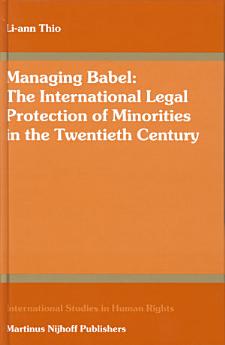
Managing Babel: The International Legal Protection of Minorities in the Twentieth Century
Jan 2005 · BRILL
Ebook
400
Pages
Tools
info
About this ebook
Minority protection is integral to a civilised standard of internal good governance. The goal of promoting friendly inter-group relations within states highlights the linkages between constitutionalism and the extending reach of international law in shaping domestic governance and structuring relations between the state, non-state communities and individuals. While law per se cannot guarantee the security and integrity of minority groups, law and legal institutions play a role in promoting a tolerant and pluralistic environment and a multicultural ethos that appreciates, rather than resents, ethno-cultural diversity. This book is a comprehensive, modern study of the important field of international protection of minority rights, focusing on 20th century developments. Minority rights regimes, which address the issue of group identity and autonomy, have essentially been a stabilising force, buttressing state survivability in the face of claims to self-determination or secession. These serve to promote the peaceful co-existence of distinct ethno-cultural groups, captured by the metaphor of ‘Babel’, within existing states. Despite overlaps, the content of minority protection is more modest than the claim of indigenous groups for collective rights or peoples’ rights to self-determination. As part of the contemporary corpus of human rights norms, minority protection may be appreciated as an aspect of the evolving content of the ‘internal’ dimension of the right to self-determination. Chapter 1 introduces some key definitional and conceptual problems in the field of minority protection and presents a brief historical review of international approaches up to 1919. Chapter 2 discusses the League of Nations era. Chapter 3 examines approaches towards minority protection after World War Two as reflected in the drafting of the United Nations Charter and efforts to protect minorities outside the UN regime. In this period, discussed in Chapters 4 and 5, minorities' issues remained largely submerged within the UN project of promoting universal individual human rights. Chapter 6 addresses the post-1989 revival in minorities' issues within the UN; Chapter 7 offers a succinct overview of what might be considered a parallel history with respect to the development of regional human rights schemes and what these afford to minority protection, closing with concluding observations.
Meticulously researched, this volume offers a valuable synthesis of this important but often heart-breaking field.
Meticulously researched, this volume offers a valuable synthesis of this important but often heart-breaking field.
Minority protection is integral to a civilised standard of internal good governance. The goal of promoting friendly inter-group relations within states highlights the linkages between constitutionalism and the extending reach of international law in shaping domestic governance and structuring rel...
Discover more
About the author
Li-ann Thio received a B.A. (Hons) from the University of Oxford, a LL.M. from Harvard Law School and a Ph.D. from the University of Cambridge and is a Barrister of Gray’s Inn, UK. She is presently an Associate Professor at the Faculty of Law, National University of Singapore, where she teaches public international law, human rights and constitutional law. Formerly Chief Editor of the Singapore Journal of International & Comparative Law, she is currently an Editor of the Singapore Yearbook of International Law and an Advisory Board member of the New Zealand Yearbook of International Law. Her publications include Constitutional Law in Malaysia & Singapore (Butterworths, 1997) and she has published numerous journal articles in the field of international law, constitutional and administrative law.
Li-ann Thio received a B.A. (Hons) from the University of Oxford, a LL.M. from Harvard Law School and a Ph.D. from the University of Cambridge and is a Barrister of Gray’s Inn, UK. She is presently an Associate Professor at the Faculty of Law, National University of Singapore, where she teaches p...
Rate this ebook
Tell us what you think.
Reading information
Smartphones and tablets
Install the Google Play Books app for Android and iPad/iPhone. It syncs automatically with your account and allows you to read online or offline wherever you are.
Laptops and computers
You can listen to audiobooks purchased on Google Play using your computer's web browser.
eReaders and other devices
To read on e-ink devices like Kobo eReaders, you'll need to download a file and transfer it to your device. Follow the detailed Help Center instructions to transfer the files to supported eReaders.