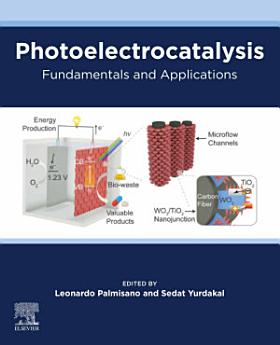
Photoelectrocatalysis: Fundamentals and Applications

·
· Elsevier
Ebook
490
Pages
Eligible

About this ebook

Photoelectrocatalysis: Fundamentals and Applications presents an in-depth review of the topic for students and researchersworking on photoelectrocatalysis-related subjects from pure chemistry to materials and environmental chemistry inorder to propose applications and new perspectives. The main advantage of a photoelectrocatalytic process is the mildexperimental conditions under which the reactions are carried out, which are often possible at atmospheric pressure androom temperature using cheap and nontoxic solvents (e.g., water), oxidants (e.g., O2 from the air), catalytic materials (e.g.,TiO2 on Ti layer), and the potential exploitation of solar light. This book presents the fundamentals and the applications of photoelectrocatalysis, such as hydrogen production fromwater splitting, the remediation of harmful compounds, and CO2 reduction. Photoelectrocatalytic reactors and lightsources, in addition to kinetic aspects, are presented along with an exploration of the relationship between photocatalysisand electrocatalysis. In addition, photocorrosion issues and the application of selective photoelectrocatalytic organictransformations, which is now a growing field of research, are also reported. Finally, the advantages/disadvantages andfuture perspectives of photoelectrocatalysis are highlighted through the possibility of working at a pilot/industrial scale inenvironmentally friendly conditions. - Presents the fundamentals of photoelectrocatalysis - Outlines photoelectrocatalytic green chemistry - Reviews photoelectrocatalytic remediation of harmful compounds, hydrogen production, and CO2 reduction - Includes photocorrosion, photoelectrocatalytic reactors, and modeling along with kinetic aspects
Photoelectrocatalysis: Fundamentals and Applications presents an in-depth review of the topic for students and researchersworking on photoelectrocatalysis-related subjects from pure chemistry to materials and environmental chemistry inorder to propose applications and new perspectives. The main a...

Discover more

About the author

Leonardo Palmisano was born in Termini Imerese, Italy, in 1950. He obtained his B.Sc. degree in Chemistry cum laude in1973 from the University of Palermo. He was a full professor of Chemistry in the Department of Engineering, University ofPalermo, since 2000, and although he has now retired, he continues to carry out research. His scientific work mainly focuseson heterogeneous photocatalysis, such as preparation, characterization of many bulk and surface techniques, and testingof various types of bare and doped polycrystalline photocatalysts. He has collaborated with many scientists worldwide,producing joint papers in international journals (~350), many scientific and didactical books, and five patents. He is editorin-chief of the Journal of Photocatalysis and a member of the editorial boards of European Journal of Inorganic Chemistry,Current Organic Chemistry, International Journal of Photoenergy, Journal of Chemistry, and Journal of Membrane Science& Technology.

Sedat Yurdakal was born in Birecik, Turkey, in 1977. He received his B.S.c. degree in Chemistry in 2000 from AnadoluUniversity, Turkey. He performed his PhD degree thesis work at the University of Palermo, Italy, and Anadolu Universityfrom 2003 to 2010. He works as a full professor at Afyon Kocatepe University. He has published many papers in prestigiousjournals (>60), a patent, books (and book chapters) in different areas of heterogeneous photocatalysis, such as greenphotocatalytic and photoelectrocatalytic oxidations, remediation of harmful compounds, thin films, photocatalytic reactorapplications, photoadsorption determination, and preparation of new materials containing TiO2. He is associate editor ofthe Journal of Photocatalysis and academic editor of the Journal of Chemistry. He has also been coeditor of special issuesof Catalysis Today
Leonardo Palmisano was born in Termini Imerese, Italy, in 1950. He obtained his B.Sc. degree in Chemistry cum laude in1973 from the University of Palermo. He was a full professor of Chemistry in the Department of Engineering, University ofPalermo, since 2000, and although he has now retired, he c...

Rate this ebook

Tell us what you think.

Reading information

Smartphones and tablets
Install the Google Play Books app for Android and iPad/iPhone. It syncs automatically with your account and allows you to read online or offline wherever you are.
Laptops and computers
You can listen to audiobooks purchased on Google Play using your computer's web browser.
eReaders and other devices
To read on e-ink devices like Kobo eReaders, you'll need to download a file and transfer it to your device. Follow the detailed Help Center instructions to transfer the files to supported eReaders.