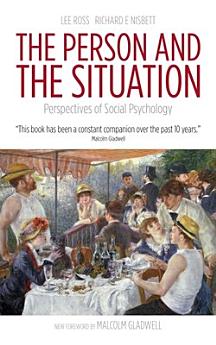
The Person and the Situation: Perspectives of Social Psychology
About this ebook
How does the situation we’re in influence the way we behave and think? Professors Ross and Nisbett eloquently argue that the context we find ourselves in substantially affects our behaviour.
“The Person and the Situation explores the complex ideas about personal versus situational determinants of behavior and relates the lessons of our discipline to important political, social, and even philosophical issues. This its the type of book that we have long wished we had available to assign to the serious, critical student who asks, ‘What have we really learned from social psychology?’ “We offer this book as a kind of throwback to a golden age and as a tribute to our intellectual forebears. We offer it as a ‘stand tall and be proud’ pep talk for our colleagues in general and for our younger colleagues in particular. We offer it as an olive branch and invitation to more fruitful intellectual dialogue with our friends in personality research (and also to our friends in anthropology and sociology who cluck, with some justification, about our parochialism). We offer it as a slim guide for non-psychologists to the heart and muscle of our enterprise. And last, but not least, we offer it as an invitation to honor the great tradition of Kurt Lewin that links basic theory first to the analysis of socially significant real-world phenomena and ultimately to the task of effective social innovation.” Lee Ross & Richard Nisbett
With a new foreword by Malcolm Gladwell, and a new afterword by the authors, this timely reissue of one of social psychology’s classic texts is essential reading for anyone with an interest in human behaviour.
“All of my books have been, in some sense, intellectual godchildren of The Person and the Situation. This book has been a constant companion over the past 10 years.” Malcolm Gladwell, in his new foreword
Ratings and reviews
About the author
Lee Ross is Professor of Psychology at Stanford University. He received his Ph.D. in psychology from Columbia University in 1969. He is co-author with Richard Nisbett of Human Inference and co-editor with John Flavell of Cognitive Social Development: Frontiers and Possible Futures. He is a founder and one of the principal investigators of the Stanford Centre on Conflict and Negotiation. His 1977 article "The Intuitive Psychologist and His Shortcomings" is the most widely cited article of the 1980s in social psychology.
Richard E. Nisbett is Theodore M Newcomb Professor of Psychology and Director of the Research Centre for Group Dynamics at the University of Michigan. He received his Ph.D. degree in Psychology from Columbia University in 1966. He taught at Yale University from 1966 to 1971. He is co-author, with Lee Ross, of Human Inference, with E. E. Jones, D. E. Kanouse, H. H. Kelley, S.Valins and B. Weiner of Attribution: Perceiving the Causes of Behavior, and with J. Holland, K. Holyoak, and P. Thagard of Induction. In 1982 he was the recipient of the Donald Campbell Award for distinguished Research in Social Psychology.