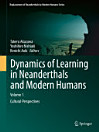
Learning Among Neanderthals and Palaeolithic Modern Humans: Archaeological Evidence

·
· Springer Nature
eBook
218
Páginas

Información sobre este eBook

This book is based on the research performed for the Replacement of Neanderthals by Modern Humans Project. The central issue of the project is the investigation of possible differences between the two populations in cognitive ability for learning. The project aims to evaluate a unique working hypothesis, coined as the learning hypothesis, which postulates that differences in learning eventually resulted in the replacement of those populations. The book deals with relevant archaeological records to understand the learning behaviours of Neanderthals and modern humans. Learning behaviours are conditioned by numerous factors including not only cognitive ability but also cultural traditions, social structure, population size, and life history. The book addresses the issues in two parts, comparing learning behaviours in terms of cognitive ability and social environments, respectively. Collectively, it provides new insights into the behavioural characteristics of Neanderthals and modern humans from a previously overlooked perspective. Furthermore, it highlights the significance of understanding learning in prehistory, the driving force for any development of culture and technology among human society.

This book is based on the research performed for the Replacement of Neanderthals by Modern Humans Project. The central issue of the project is the investigation of possible differences between the two populations in cognitive ability for learning. The project aims to evaluate a unique working hyp...

Descubre más

Acerca del autor

Yoshihiro Nishiaki, who received his Ph.D. from University College London, is a professor of prehistory at the University Museum, The University of Tokyo. His research involves the archaeology of West and Central Asia mainly through technological analyses of flaked stone artifacts. He has directed numerous field investigations in West and Central Asia since 1984, including Paleolithic and Neolithic excavations in Syria, Azerbaijan, Iran, and Uzbekistan. He is currently the director of PaleoAsia, a large-scale research project investigating the formation processes of modern human cultures in Asia, supported by the Ministry of Education, Culture, Sports, Science and Technology, Japan. He has served on the editorial board or scientific committee of a number of international associations, such as the International Union for Quaternary Research, the International Union of Prehistoric and Protohistoric Sciences, and Association Paléorient.

Olaf Jöris received his Ph.D. from the University of Cologne, Germany. He is senior scientist at and deputy head of the MONREPOS Archaeological Research Centre and Museum for Human Behavioural Evolution in Neuwied, Germany – a department of the Römisch-Germanisches Zentralmuseum Mainz, Leibniz Research Institute for Archaeology. His research focuses on the archaeological evidence for understanding the evolution of human behaviour from a diachronic perspective. He has directed fieldwork in Germany, Georgia, and China. He has been involved in numerous inter- and transdisciplinary projects, regularly serves as reviewer or editor in international journals, and is member of several international research organizations. He teaches prehistoric archaeology at the Johannes Gutenberg University Mainz, Germany, and, since 2014, has been a visiting professor at Lanzhou University, Gansu Province, China.
Yoshihiro Nishiaki, who received his Ph.D. from University College London, is a professor of prehistory at the University Museum, The University of Tokyo. His research involves the archaeology of West and Central Asia mainly through technological analyses of flaked stone artifacts. He has directe...

Valorar este eBook

Danos tu opinión.

Información sobre cómo leer

Smartphones y tablets
Instala la aplicación Google Play Libros para Android y iPad/iPhone. Se sincroniza automáticamente con tu cuenta y te permite leer contenido online o sin conexión estés donde estés.
Ordenadores portátiles y de escritorio
Puedes usar el navegador web del ordenador para escuchar audiolibros que hayas comprado en Google Play.
eReaders y otros dispositivos
Para leer en dispositivos de tinta electrónica, como los lectores de libros electrónicos de Kobo, es necesario descargar un archivo y transferirlo al dispositivo. Sigue las instrucciones detalladas del Centro de Ayuda para transferir archivos a lectores de libros electrónicos compatibles.