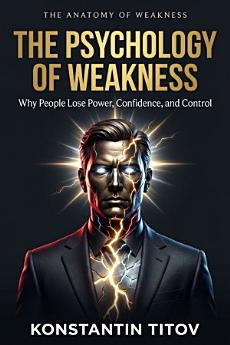
About this ebook
A person says yes when they mean no. They soften a true statement before anyone objects. They wait too long to respond to disrespect. They over-explain a reasonable boundary. They mistake silence for patience, avoidance for maturity, and self-suppression for kindness. By the time the visible consequences arrive, the real loss has already happened.
The Psychology of Weakness examines the hidden patterns through which people surrender power, confidence, and control long before open defeat. Instead of treating weakness as a simple personality flaw, this book shows how it develops through fear, self-doubt, approval-seeking, conflict avoidance, hesitation, emotional dependency, and the quiet habit of retreating from discomfort.
Through sharp psychological observation and many realistic examples, the book explores how weakness forms in everyday life: in meetings where capable people lower their own position before speaking, in relationships where fear of tension leads to self-erasure, in families where guilt replaces honest boundaries, in negotiations where value is surrendered too early, and in careers where talented people become easy to ignore because they present themselves with hesitation rather than authority.
This is not a book about aggression, domination, or empty self-help slogans. It is a serious, readable examination of how people begin to lose themselves in small, socially acceptable ways. It shows how weakness hides behind politeness, caution, flexibility, patience, and the desire to be liked. It explains why so many people recognize their surrender only after the moment has passed, after the email is sent, after the silence is chosen, after the concession is made.
Across work, ambition, love, family dynamics, status, and self-respect, The Psychology of Weakness gives language to a problem many people feel but rarely define clearly: the experience of knowing that something in them keeps stepping back too early. It reveals how weakness shows itself in speech, timing, posture, emotional adjustment, and the body’s first signals of self-betrayal. It also shows why these patterns often begin as intelligent adaptations to pressure, then harden into identity over time.
For readers interested in power, influence, confidence, boundaries, respect, and the psychology of human behavior, this book offers a different and more unsettling question: not how people gain power, but how they quietly lose it before anyone has to take it.
Clear, psychologically exact, and deeply relevant, this book is for anyone who wants to understand the hidden mechanics of weakness and recognize them before another small surrender becomes a larger life pattern.
About the author
Konstantin Titov is an author whose work explores the hidden architecture of human behavior: power, weakness, perception, hesitation, control, ambition, collapse, and the psychological patterns that shape visible outcomes long before they are recognized.
Across his nonfiction writing, he examines the forces that quietly govern decision-making, self-respect, influence, status, and inner authority, with particular attention to the subtle ways people undermine themselves while believing they are merely adapting to reality. His books are marked by a serious, unsentimental style that combines psychological sharpness with practical human observation.
In The Psychology of Weakness, Titov examines how fear, self-doubt, approval-seeking, delay, and conflict avoidance quietly strip people of power, confidence, and control, often long before any open defeat occurs. His work is written for readers who seek not slogans, but a deeper understanding of the invisible mechanics that shape human lives.