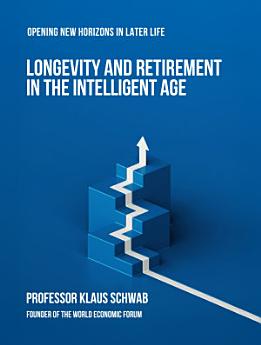
Longevity and Retirement in the Intelligent Age: Opening New Horizons in Later Life
About this ebook
In the second volume of his Intelligent Age Series, Klaus Schwab challenges outdated assumptions about aging, work, and purpose. With longer lifespans, today’s older adults are healthier, more educated, and more active than ever. Their experience and wisdom are invaluable, offering society the chance to harness and celebrate them.
Longevity and Retirement in the Intelligent Age shows how businesses, communities, and individuals can harness the untapped potential of aging employees and retirees. When fully engaged, older adults can drive innovation, mentorship, and meaningful contributions that benefit everyone.
This book also explores how technology and AI can power lifelong learning, skill-building, and productivity, turning retirement from an ending into the start of a purposeful, opportunity-filled chapter.
Get ready to:
Challenge conventional ideas about aging and discover how longer, healthier lives open doors to new opportunities.
Tap into the skills, wisdom, and energy of older adults to drive impact in business, community, and personal life.
Leverage AI and modern tools to keep learning, growing, and making a difference at any stage of life.
Whether you’re approaching retirement, managing a multigenerational workforce, or simply curious about the future of aging, this book offers a roadmap to a vibrant, impactful second half of life.
The future of aging isn’t about slowing down. It’s about stepping up.
Discover more
About the author
Professor Klaus Schwab (1938, Ravensburg, Germany) is the Founder of the World Economic Forum. In 1971, he published Modern Enterprise Management in Mechanical Engineering. He argues in that book that a company must serve not only shareholders but all stakeholders to achieve long-term growth and prosperity. To promote the stakeholder concept, he founded the World Economic Forum the same year.
Professor Schwab holds doctorates in Economics (University of Fribourg) and in Engineering (Swiss Federal Institute of Technology) and obtained a master’s degree in Public Administration (MPA) from the Kennedy School of Government at Harvard University.
In 1972, in addition to his leadership role at the Forum, he became a professor at the University of Geneva.
He has received numerous international and national honors, including 20 honorary doctorates.
His books include The Fourth Industrial Revolution (2016), a worldwide bestseller translated into 30 languages, Shaping the Future of the Fourth Industrial Revolution (2018), The Great Reset (2020), and Stakeholder Capitalism (2021).