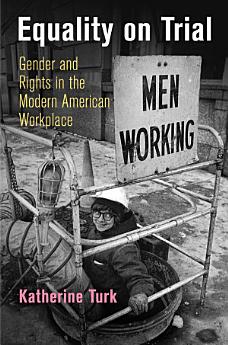
Equality on Trial: Gender and Rights in the Modern American Workplace
Apr 2016 · University of Pennsylvania Press
Ebook
296
Pages
Tools
info
family_home
Eligible
info
About this ebook
In 1964, as part of its landmark Civil Rights Act, Congress outlawed workplace discrimination on the basis of such personal attributes as sex, race, and religion. This provision, known as Title VII, laid a new legal foundation for women's rights at work. Though President Kennedy and other lawmakers expressed high hopes for Title VII, early attempts to enforce it were inconsistent. In the absence of a consensus definition of sex equality in the law or society, Title VII's practical meaning was far from certain.
The first history to foreground Title VII's sex provision, Equality on Trial examines how the law's initial promise inspired a generation of Americans to dispatch expansive notions of sex equality. Imagining new solidarities and building a broad class politics, these workers and activists engaged Title VII to generate a pivotal battle over the terms of democracy and the role of the state in all labor relationships. But the law's ambiguity also allowed for narrow conceptions of sex equality to take hold. Conservatives found ways to bend Title VII's possible meanings to their benefit, discovering that a narrow definition of sex equality allowed businesses to comply with the law without transforming basic workplace structures or ceding power to workers. These contests to fix the meaning of sex equality ultimately laid the legal and cultural foundation for the neoliberal work regimes that enabled some women to break the glass ceiling as employers lowered the floor for everyone else.
Synthesizing the histories of work, social movements, and civil rights in the postwar United States, Equality on Trial recovers the range of protagonists whose struggles forged the contemporary meanings of feminism, fairness, and labor rights.
In 1964, as part of its landmark Civil Rights Act, Congress outlawed workplace discrimination on the basis of such personal attributes as sex, race, and religion. This provision, known as Title VII, laid a new legal foundation for women's rights at work. Though President Kennedy and other lawmake...
Discover more
About the author
Katherine Turk is Associate Professor of History and Adjunct Associate Professor of Women's and Gender Studies at the University of North Carolina, Chapel Hill.
Katherine Turk is Associate Professor of History and Adjunct Associate Professor of Women's and Gender Studies at the University of North Carolina, Chapel Hill.
Rate this ebook
Tell us what you think.
Reading information
Smartphones and tablets
Install the Google Play Books app for Android and iPad/iPhone. It syncs automatically with your account and allows you to read online or offline wherever you are.
Laptops and computers
You can listen to audiobooks purchased on Google Play using your computer's web browser.
eReaders and other devices
To read on e-ink devices like Kobo eReaders, you'll need to download a file and transfer it to your device. Follow the detailed Help Center instructions to transfer the files to supported eReaders.