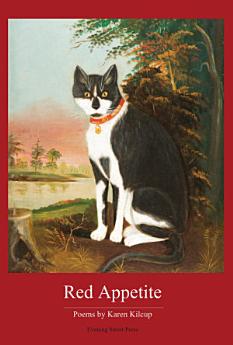
Red Appetite
About this ebook
isolation due to covid brought nature to our doors, examining human kindness
and cruelty as it encroaches. In “Squunck” the skunk observes us as well. “I live
/ in open air, uncontained / by the doors like coffin lids / that suffocate you inside
/your fancy boxes.” Kilcup also laments isolation. In “On Not Being Touched”
she writes, “I envy the river rocks / for the water curling over / their backs.” In
“Belgian Mare and Foal” Kilcup celebrates a birth: “A flurry of legs / the pour of
a creamy tail, / the flash of a russet back. / The mare observes, and nods.” I am
enamored of Karen Kilcup’s work and am honored to have had the chance to
publish two of the poems from this collection. —Lee (Lori) Desrosiers, author of
The Philosopher’s Daughter, Sometimes I Hear the Clock Speak, and Keeping
Planes in the Air, and editor of Naugatuck River Review and Wordpeace
All too often we humans are guilty of a “habit / of not seeing what’s there,” as
Karen Kilcup claims in her poem “The Sixth Cat.” But in these poems, she pays
attention. Red Appetite is filled with close looks at the myriad of creatures that
share our planet, from the tiny water striders that “cannot see / the quick shadow
/ that glides beneath / the river’s lucent skin, / the gulf that lies / below” to the
bobcat, the “graceful spotted ghost,” that “leaves behind a chill that never /
eases.” From a deep observation of the small lives we often glimpse in our wild
and more-domesticated spaces, these poems deftly straddle a first-time
gardener’s fierce frustration with the wild pillagers that seek the same bitter
greens in spring as we do, and the often humorous empathy for those small lives
we too often overlook.
—Katherine Solomon, author of Tempting Fate
Red Appetite is a taxonomy of the joy and quirks of animals that live around us,
haunted all the while by death and the COVID lockdown. In these tight, lyrical
poems, mortality hunts the speaker like the bobcat that stalks the barnyard and
the woodchuck that undermines the garden. These poems echo Maxine Kumin’s
ethical introspection while others hint at the starkness of Robinson Jeffers’
animal poems. The music here allows the reader a taste of the sublime in the
midst of a world that is always falling and rising:
The neighbor’s ornamental cherry tree / sags with blooms. Too soon, /
they’ll wash the dark ground / with pink, soft underfoot, as if / someone
holding her breath / exhaled.
Red Appetite is a focused meditation on how we are reflected in these animals,
both domesticated like the barnyard cat or mare, and more wild like the possum,
junco, and bobcat. Kilcup’s collection is a nuanced read that leads one to rejoice
in spring and reflect that new life is due only to the coldness brought by winter.
—Gregory Byrd, author of The Name for the God Who Speaks, winner of the
2018 Robert Phillips Prize
Discover more
About the author
Karen Kilcup has written poetry for four decades, but began
submitting it for publication only in mid-2021. Over seventy-five of
her poems appear in anthologies and various journals, including
Poet Lore, Poetry East, Caesura, Hole in the Head Review, and
storySouth. Her chapbook Black Nebula is forthcoming from Grey
Books Publishing, and her forthcoming full-length collection The
Art of Restoration won the 2021 Winter Goose Poetry Prize. In
2022, her poem “Old Growth” received an honorable mention for
the New England Poetry Club’s E. E. Cummings Poetry Prize, and
her “Feathers and Wedges” received the Julia Peterkin Literary
Award for Poetry from South 85 journal and was nominated for a
Pushcart Prize.
Karen Kilcup grew
up in an old
farming family
with the company
of many animals.
She loves cats,
especially her most
recent feline, Easy
An avid cook,
gardener, runner,
kayaker, and rock
climber, Kilcup
lives in coastal
New Hampshire
with the love of
her life, Alan.
Karen Kilcup
“Feathers and Wedges” https://www.south85journal.
winter-2020/fall-winter-2022-
karen-kilcup/
“Old Growth” https://nepoetryclub.org/
golden-shovel/